
How a Market Intelligence Firm Validates Investment Theses Before an Acquisition
An acquisition may look attractive on paper, with strong revenue growth, a growing customer base, and a promising market outlook. However, investors need to establish whether these results reflect sustainable business performance or assumptions that have not been tested against market evidence. A market intelligence firm helps investors examine these assumptions through industry research, customer insights, competitive analysis, and direct input from professionals with relevant market experience.
For private equity firms, investment teams, and management consultants, this research provides a clearer understanding of the commercial factors that can influence an acquisition’s success. It helps determine whether the target company’s growth opportunities are credible, its competitive position is defensible, and its business model can support the investment thesis.
All of this matters before an acquisition is completed, when identifying an unsupported assumption can influence valuation, negotiations, and the final investment decision.
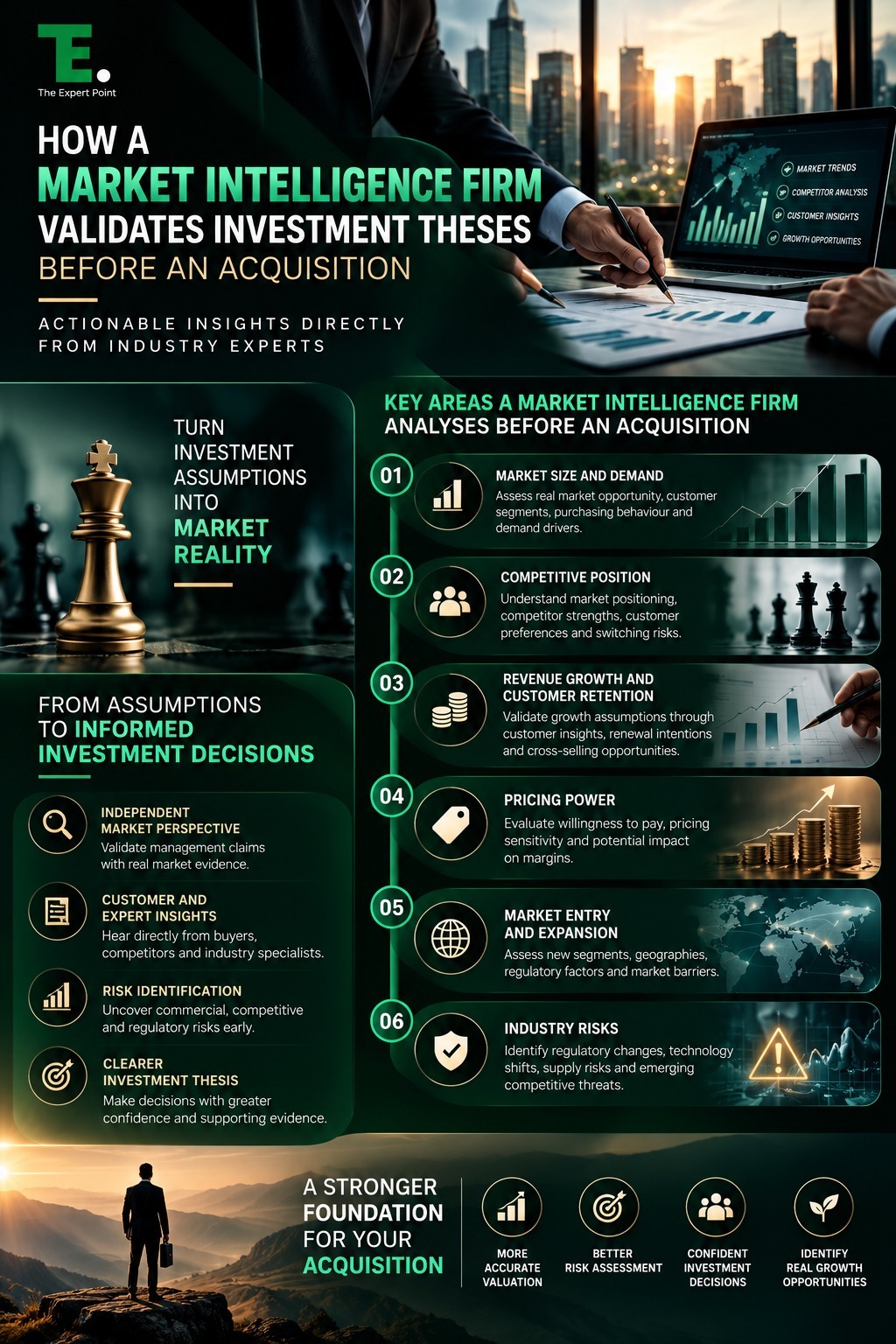
What to Evaluate: The Short Version
Before committing to an acquisition, investors should examine the assumptions that support the target company’s expected future performance.
Key questions include:
- Is the target company’s addressable market supported by credible demand?
- Does the company have a defensible competitive advantage?
- Are revenue growth and customer retention assumptions realistic?
- Will customers accept planned price increases?
- Can the company expand into new markets or customer segments?
- What industry developments could weaken future performance?
- Are the investment assumptions supported by independent evidence?
- Can expert interviews and primary research validate management projections?
- Have potential market, operational, and compliance risks been considered?
- Does the research directly address the investment thesis?
A structured approach helps investors focus on the commercial questions that could materially affect the acquisition rather than collecting information without a clear purpose.
Why Investment Theses Need Independent Market Validation
An investment thesis explains why an acquisition is expected to create value. It may rely on assumptions about market growth, customer demand, pricing power, operational improvements, or expansion into new segments.
Management presentations and financial statements provide important information, but they do not always explain the conditions behind reported performance. A company may be growing because of temporary market conditions, a small number of large customers, aggressive discounting, or unusually strong demand that competitors could soon challenge.
Independent market research examines these assumptions from outside the target company’s perspective. It helps investors distinguish between established strengths, credible opportunities, and risks that require further investigation.
For example, if a target company expects to increase revenue by entering an adjacent market, investors need to understand whether buyers in that market have a genuine need for its products, whether competitors already serve that demand, and whether the company has the capabilities required to compete.
The objective is not simply to confirm the investment thesis. It is to test whether the assumptions behind it are supported by credible commercial evidence.
Start With the Investment Thesis, Not the Research Provider
Before selecting a research partner, define what you need to establish about the target company. Broad requests such as “we need information about the healthcare market” rarely provide enough direction for focused due diligence.
Instead, identify the assumptions that matter to the investment decision and turn them into specific research questions.
For example:
- Is the target market growing at the rate projected by management?
- What factors influence customer purchasing and supplier selection?
- Why do customers choose the target company over competitors?
- Will customers accept higher prices without reducing purchases?
- What could prevent the company from entering a new market?
- Which industry developments could affect future demand?
Specific questions help determine whether the research should involve customer interviews, primary surveys, industry expert consultations, competitor analysis, or a combination of methods.
They also provide a way to assess the research provider. A capable partner should be able to explain how it would investigate each question, identify the relevant sources of evidence, and connect the findings to the investment thesis.
Test Market Size and Demand Assumptions
A large addressable market does not automatically translate into a strong investment opportunity. Investors need to understand how much of that market the target company can realistically serve and what factors influence purchasing decisions.
A market intelligence firm can investigate market demand by examining:
- Addressable customer segments: Which customers have a relevant need and the resources to purchase the product or service?
- Purchase behaviour: How frequently do customers buy, and what influences their supplier selection?
- Demand drivers: Which industry developments, regulatory changes, technologies, or business needs affect demand?
- Adoption barriers: What prevents potential customers from switching suppliers or adopting a new solution?
- Market growth: Is demand expanding across relevant segments, or is growth concentrated in a limited part of the market?
Industry reports can provide an initial market estimate, but primary research helps explain the commercial conditions behind it. Interviews with customers, suppliers, distributors, and industry professionals can reveal whether projected demand is supported by actual purchasing behaviour.
This distinction is particularly important when an investment thesis depends on rapid market expansion. Investors need evidence that the target company can reach relevant buyers, meet their requirements, and convert demand into revenue.
Evaluate the Target Company's Competitive Position
A company’s historical performance may suggest that it has a strong market position. However, investors need to understand why customers choose the business and whether those reasons will remain relevant after an acquisition.
Competitive intelligence examines the target company’s position relative to direct competitors and alternative solutions. It considers product differentiation, service quality, distribution reach, customer relationships, switching costs, and the factors that influence purchasing decisions.
Research can address questions such as:
- Why do customers select the target company over competing providers?
- Which competitors are gaining traction in the same customer segments?
- Are customers satisfied with the target company’s product quality, service, and support?
- How easily could buyers switch to another supplier?
- Does the company have a meaningful advantage, or does it compete mainly on price?
Customer interviews and industry expert consultations can uncover competitive weaknesses that may not appear in financial reports. For instance, a business may report strong customer retention because switching suppliers is inconvenient, even though customers are dissatisfied with its service.
Investors can use these findings to assess the durability of the company’s competitive advantage and the risk of losing market share.
Validate Revenue Growth and Customer Retention
Revenue forecasts are central to many acquisition decisions. Yet projected growth may depend on assumptions about customer renewals, new account acquisition, higher spending, or cross-selling additional products.
Market intelligence helps test whether these assumptions align with customer behaviour and market conditions.
Research with current customers can reveal satisfaction levels, future purchasing intentions, unmet needs, and the likelihood of continuing the relationship. Discussions with former customers and lost prospects can uncover reasons for churn, weak product adoption, pricing objections, and competitive displacement.
Investors should also distinguish between different sources of expected growth:
- Existing customer growth: Will customers increase spending, renew contracts, or purchase additional services?
- New customer acquisition: Is the company winning new customers at a sustainable rate?
- Price increases: Will buyers accept higher prices without reducing usage or switching suppliers?
- Cross-selling: Do customers need additional products, and are budgets available?
- Market expansion: Can the company reach new segments without significantly increasing acquisition costs?
Customer feedback should be compared with historical revenue, renewal records, contract terms, and pipeline conversion rates. Stated purchase intentions are useful evidence, but they do not guarantee future sales.
This analysis helps investors determine whether the growth forecast rests on observable customer demand or depends on expectations that require further validation.
Assess Pricing Power and Profitability Risks
Revenue growth can conceal weaknesses in a company’s pricing strategy. A business may increase sales by offering substantial discounts, extending favourable payment terms, or absorbing additional service costs. These practices can support short-term growth while putting pressure on margins.
A market intelligence firm can investigate how customers perceive the target company’s value and how they respond to changes in price. Research may examine willingness to pay, competing offers, procurement practices, contract structures, and the importance of price relative to quality or service.
Interviews with buyers and industry specialists can also help establish whether the target company has pricing flexibility or operates in a market where customers can easily negotiate lower rates.
For example, if a software provider expects to raise subscription prices after an acquisition, investors should establish whether customers consider the product essential, whether alternatives are readily available, and whether the proposed increase is consistent with market expectations.
These findings help investors assess the credibility of revenue projections and identify commercial risks that may affect profitability.
Examine Market Entry and Expansion Opportunities
Many acquisition strategies depend on expanding into new geographies, customer segments, or product categories. These opportunities can create additional value, but they also introduce uncertainty.
A target company’s success in one market does not guarantee similar performance elsewhere. Customer requirements, purchasing processes, competitive conditions, distribution structures, and regulatory obligations may differ significantly.
Market intelligence research helps assess whether an expansion plan is commercially realistic. Relevant questions include:
- Is there sufficient demand in the proposed market?
- Which customer groups are most likely to purchase?
- How established are local competitors?
- What distribution partnerships or sales capabilities are required?
- What barriers could delay adoption or increase market-entry costs?
- Can the target company’s existing products and capabilities meet local requirements?
Primary surveys can help quantify customer preferences and purchasing intentions, while expert interviews can provide context about industry practices, channel relationships, and local market conditions.
This evidence helps investors assess the resources, time, and commercial adjustments required to execute the expansion strategy.
Identify Industry Risks and Potential Disruptions
An investment thesis may be weakened by external developments that are not fully reflected in the target company’s historical performance. Changes in technology, regulation, customer expectations, supplier availability, or competitive behaviour can alter the economics of a business.
Market intelligence research helps investors identify these risks and examine their potential consequences.
In healthcare and pharmaceuticals, regulatory developments and changes in treatment practices may affect demand. In information technology, new platforms or competing solutions may change customer purchasing priorities. In industrial manufacturing, supply constraints, input costs, and shifts in production requirements may influence margins and delivery performance.
Industry experts can provide context on how these developments affect businesses operating in the relevant sector. Their perspectives can help investors identify risks that require further analysis, although expert opinions should be assessed alongside independent evidence rather than treated as definitive forecasts.
The objective is to understand which external factors could change the target company’s growth prospects and whether its strategy accounts for those risks.
Evaluate the Research Process and Evidence Quality
The usefulness of market intelligence depends on the relevance of the evidence and how it is collected. Investors should assess the research process before relying on its findings.
When evaluating a research partner, consider the following:
- Research alignment: Does the provider understand the investment thesis and the questions that need to be answered?
- Expert relevance: Can it identify professionals with direct experience in the relevant industry, function, and geography?
- Screening procedures: Are experts assessed against the specific research brief?
- Primary research capabilities: Can the provider coordinate customer interviews, surveys, and industry consultations when required?
- Compliance practices: Are confidentiality, conflicts of interest, and restrictions on sensitive information addressed?
- Research deliverables: Will findings be presented in a format that supports the investment decision?
- Turnaround times: Can the research be completed within the acquisition timeline?
Investors should also establish how conflicting perspectives will be handled and what limitations apply to the evidence. Clear objectives and transparent methods help ensure that the research addresses the actual commercial questions behind the deal.
The Investment Thesis Validation Checklist
Investors can use the following checklist when preparing a due diligence brief or evaluating a market intelligence provider.
| What to validate | Question to investigate | Evidence to look for |
|---|---|---|
| Market demand | Is the target market growing as projected? | Segment-level demand, buyer needs, purchasing behaviour |
| Competitive position | Why do customers choose the target company? | Customer feedback, competitor capabilities, switching costs |
| Revenue growth | Are growth forecasts commercially realistic? | Renewal data, sales pipeline, customer intentions |
| Pricing power | Can the company raise prices without losing customers? | Willingness to pay, alternatives, pricing sensitivity |
| Expansion | Can the company enter new markets successfully? | Local demand, distribution requirements, adoption barriers |
| Industry risks | What could weaken future performance? | Regulatory changes, technology shifts, supplier and market risks |
| Research quality | Does the evidence address the investment thesis? | Relevant experts, transparent methodology, documented findings |
| Compliance | Can the research withstand internal review? | Screening procedures, engagement terms, compliance documentation |
Once the research is complete, findings should be compared with the target company’s financial records, customer contracts, commercial pipeline, and management forecasts.
Each assumption can then be classified as supported by available evidence, requiring further validation, or challenged by the findings. Where evidence is incomplete or contradictory, investors can commission additional research before reaching a conclusion.
This approach makes market intelligence a practical part of investment evaluation rather than a separate research exercise.
How The Expert Point Supports Investment and Market Intelligence Research
At The Expert Point, we connect investment teams, consulting firms, and corporate researchers with subject matter experts whose experience matches their project requirements. Our researchers clarify research objectives, identify relevant professionals across industries, screen candidates for suitability, and coordinate expert interviews, primary surveys, and in-person meetings. We support research across sectors including healthcare and pharmaceuticals, information technology, chemicals and materials, automotive, energy, industrial manufacturing, financial markets, and other specialised fields. Through our project-specific expert matching and global industry reach, we help clients investigate market demand, customer behaviour, competitive conditions, and industry risks. Our focus is on connecting clients with relevant first-hand industry knowledge to help them examine investment assumptions and make better-informed strategic decisions.
Choosing a Market Intelligence Partner That Fits the Investment
The right research partner should understand the investment question, identify relevant evidence, and match expertise to the specific market or business issue. A large research database or broad industry coverage may be useful, but neither guarantees that the findings will address the assumptions that matter to the acquisition.
Investors should look for a provider that can explain its research approach, demonstrate relevant industry access, screen experts against the project brief, and deliver findings within the required timeframe. Compliance procedures, clear communication, and transparent research limitations are equally important.
The final choice should reflect the needs of the deal. A specialised acquisition may require deep expertise in one industry or geography, while a broader transaction may call for research across several markets. In both cases, the goal is to obtain credible evidence that helps investors evaluate the commercial potential of the target company.
How The Expert Point Supports Investment and Market Intelligence Research
At The Expert Point, we connect investment teams, consulting firms, and corporate researchers with subject matter experts whose experience matches their project requirements. Our researchers clarify research objectives, identify relevant professionals across industries, screen candidates for suitability, and coordinate expert interviews, primary surveys, and in-person meetings. We support research across sectors including healthcare and pharmaceuticals, information technology, chemicals and materials, automotive, energy, industrial manufacturing, financial markets, and other specialised fields. Through our project-specific expert matching and global industry reach, we help clients investigate market demand, customer behaviour, competitive conditions, and industry risks. Our focus is on connecting clients with relevant first-hand industry knowledge to help them examine investment assumptions and make better-informed strategic decisions.
Conclusion
Validating an investment thesis requires more than reviewing financial statements and management projections. Investors need to establish whether the market conditions, customer behaviour, competitive position, and growth opportunities behind those projections are supported by credible evidence.
A market intelligence firm helps examine these factors through targeted research, customer insights, competitive analysis, and consultations with relevant industry professionals. When findings are linked directly to the investment thesis, investors can identify unsupported assumptions, assess commercial risks, and develop a clearer view of the target company’s future prospects.
For private equity firms, investment teams, and commercial due diligence consultants, this evidence provides a stronger foundation for evaluating an acquisition and deciding which opportunities justify further investment.
Looking for Relevant Industry Expertise for Your Next Acquisition?
Tell us your research requirement and we will identify expertise aligned with your investment questions.
Frequently Asked Questions
A market intelligence firm validates an investment thesis by examining market demand, customer behaviour, competitive positioning, pricing power, and growth opportunities. It uses industry research, customer interviews, primary surveys, and expert consultations to test whether the assumptions behind an acquisition are supported by credible market evidence.
Market intelligence helps private equity firms assess whether a target company’s growth prospects and competitive advantages are sustainable. It can reveal risks such as customer concentration, weak pricing power, changing market demand, and competitive pressure that may affect the investment’s expected returns.
Common methods include industry analysis, customer interviews, primary surveys, competitor benchmarking, and consultations with relevant industry experts. Combining these methods with financial records, customer contracts, and sales pipeline data helps investors evaluate revenue forecasts and identify assumptions that require further investigation.
Financial statements show historical performance but may not explain why customers choose a company, what drives customer loyalty, or how competitors influence purchasing decisions. Market intelligence research can uncover customer dissatisfaction, switching risks, pricing pressure, emerging competitors, and barriers to expansion that could affect future performance.
At The Expert Point, we connect investment teams, consulting firms, and corporate researchers with relevant subject matter experts for project-specific research requirements. Through our expert interviews, primary surveys, and in-person meetings, we help clients investigate market demand, customer behaviour, competitive dynamics, and industry risks to assess investment assumptions and support informed acquisition decisions.