
How Voice of Customer Research Validates Revenue Growth Assumptions in Commercial Due Diligence
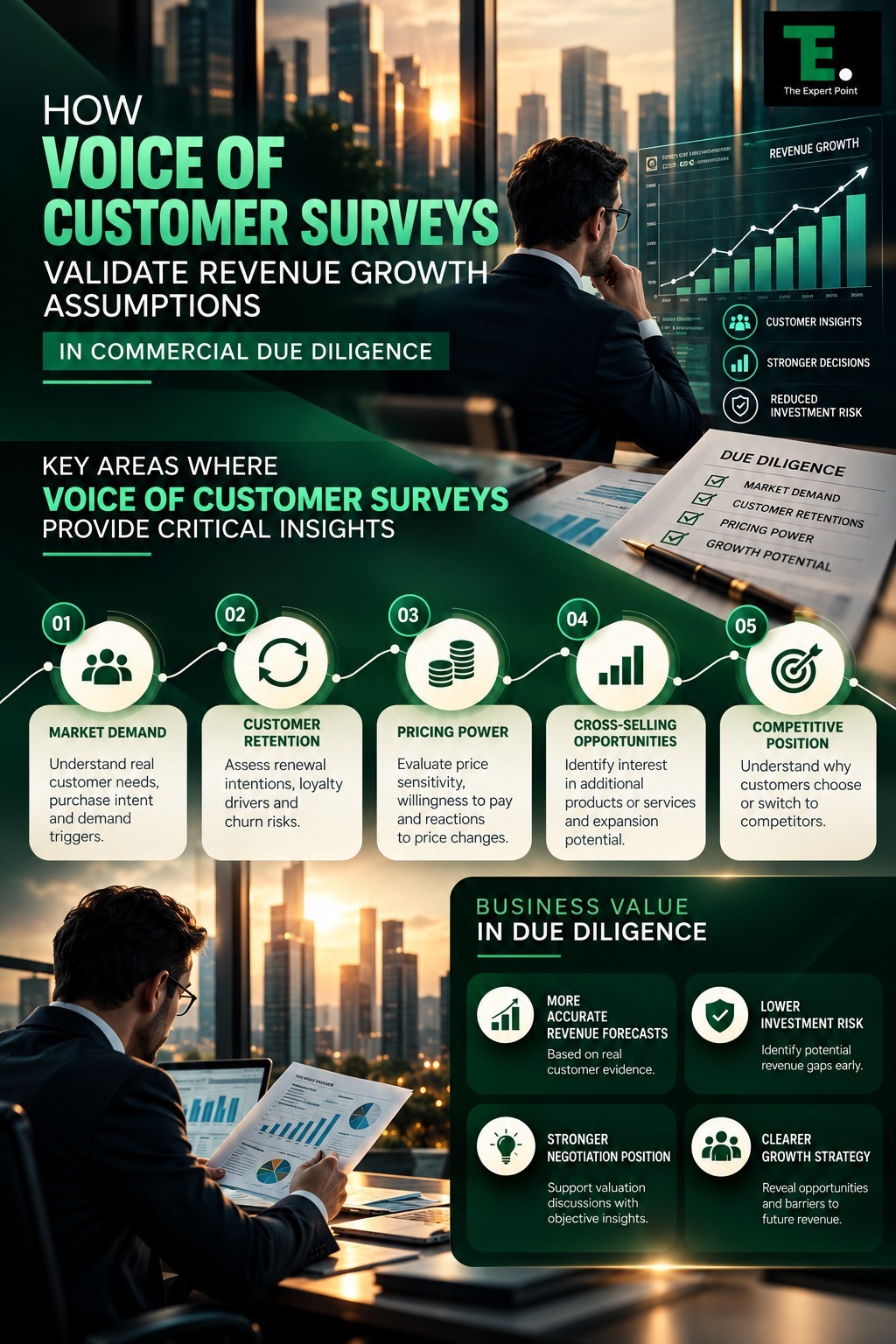
Revenue growth is one of the most closely examined assumptions in commercial due diligence. A business may report rising sales, a growing customer base, and strong demand projections, but investors need to understand whether those results can continue after an acquisition. Voice of customer surveys help validate revenue growth assumptions by examining customer needs, purchasing decisions, willingness to pay, retention risks, and the factors that influence future demand.
Financial statements show what a company has achieved. Customer research helps explain why customers buy, what keeps them loyal, and whether the conditions supporting past growth are likely to persist. For private equity firms, investment teams, and commercial due diligence consultants, this evidence can reveal whether a growth forecast reflects genuine market demand or depends on assumptions that require closer examination.
What to Evaluate: The Short Version
Before relying on a company’s revenue growth projections, investors should examine the customer behaviours and commercial conditions behind those forecasts.
Key questions include:
- Do customers have a genuine need for the company’s products or services?
- Is market interest likely to translate into actual purchases?
- Are existing customers likely to renew their contracts and maintain spending?
- Will customers accept planned price increases?
- Are cross-selling and expansion opportunities supported by customer demand?
- Could competitors attract customers away from the target company?
- What barriers could delay or prevent purchasing decisions?
- Are survey respondents representative of the company’s actual customer base?
- Do customer responses align with historical sales and contract data?
- Which growth assumptions are supported, uncertain, or challenged by the evidence?
Customer research should not simply confirm management’s expectations. It should establish which revenue drivers have credible support and which require further investigation.
Why Revenue Growth Assumptions Need Customer Validation
During commercial due diligence, investors assess whether a company’s projected revenue is supported by market conditions and customer behaviour. Management forecasts may assume higher sales, improved customer retention, increased prices, or expansion into new segments. Each assumption needs a clear commercial basis.
For example, a software provider may forecast substantial growth because several customers have expressed interest in additional modules. However, interest does not guarantee a purchase. Buyers may delay implementation, reduce budgets, choose competing products, or decide that the additional features do not justify the cost.
Customer research helps test these assumptions against the experiences and intentions of actual buyers.
It can help investors investigate:
- Which problems customers are trying to solve.
- What factors influence their purchasing decisions.
- Whether customers intend to renew, expand, or reduce their spending.
- How customers respond to price changes.
- Which competitors could capture future demand.
- What prevents prospective customers from making a purchase.
The objective is to distinguish between credible growth drivers and assumptions that may be overly optimistic. Customer evidence should be assessed alongside financial performance, market conditions, and the target company’s commercial strategy.
Start With the Revenue Assumptions, Not the Survey
A customer survey is only useful when it addresses a specific commercial question. A general satisfaction questionnaire may generate feedback, but it might not reveal whether a company’s revenue forecast is achievable.
Before commissioning research, investors should identify the assumptions that have the greatest influence on the investment case.
For example:
- Will new customers purchase within the forecast period?
- Will existing customers renew at the expected rate?
- Can the company increase prices without losing customers?
- Will customers purchase additional products or services?
- Can the company attract customers from competing providers?
Each question requires a suitable research approach. Purchase intent may require interviews with prospective buyers, while renewal risk may require conversations with existing and former customers. Pricing assumptions may require research into willingness to pay, competing offers, and purchasing behaviour.
A well-defined research brief also helps determine which respondents should be included, what questions should be asked, and how the results will be evaluated.
The same principle applies when selecting a research partner. Ask how the provider will connect the research questions to the revenue assumptions being tested, rather than focusing only on survey volume or the number of respondents.
Test Market Demand and Purchase Intent
A company’s addressable market may appear attractive based on industry reports, market size estimates, and projected growth rates. However, a large market does not necessarily translate into demand for a particular business.
Voice of customer surveys help researchers understand whether prospective and existing customers have a genuine need for the company’s offering, how they currently address that need, and what might encourage them to spend more.
For instance, an industrial equipment supplier may operate in a market benefiting from factory automation. That broader trend does not establish how many manufacturers intend to purchase its equipment, when they expect to invest, or whether they will choose the company over established alternatives.
Research should examine:
- Purchase intent: Do customers expect to purchase within a defined period?
- Demand triggers: Which operational, financial, or regulatory changes create a need?
- Purchase timing: Are buying decisions imminent, planned, or speculative?
- Budget availability: Have customers allocated funds for the purchase?
- Adoption barriers: What could delay or prevent a buying decision?
- Supplier preference: Which providers would customers consider, and why?
These findings help investors distinguish between general market interest and demand that could realistically contribute to revenue.
Survey responses should not be treated as guaranteed future sales. Researchers should compare stated intentions with past purchasing behaviour, procurement timelines, budget commitments, and other available evidence.
Evaluate Customer Retention and Recurring Revenue
Revenue growth depends not only on acquiring new customers but also on retaining existing ones. A company with a high renewal rate may appear stable, yet that figure does not always reveal the strength of customer relationships.
Some customers renew because switching providers would be expensive or disruptive. Others may remain under contract while actively evaluating alternatives. If the company relies on these customers to support future growth, investors need to understand whether their continued spending is likely.
Customer research can examine the reasons behind retention and identify early signs of revenue risk.
Important areas to investigate include:
- Renewal intentions: Whether customers expect to continue using the company’s products or services.
- Customer dependence: Whether the offering is essential to daily operations or relatively easy to replace.
- Switching behaviour: Whether customers have evaluated competing providers or considered bringing services in-house.
- Unmet expectations: Whether service quality, delivery, reliability, or support issues could affect renewal decisions.
- Expansion potential: Whether customers expect to purchase additional products, increase usage, or enter longer-term agreements.
The findings should be compared with customer-level revenue records, contract renewal dates, churn rates, and historical spending patterns. A positive survey response is useful, but actual purchasing behaviour provides a stronger basis for assessing revenue durability.
Commercial due diligence can also benefit from including former customers and lost prospects. Their feedback may reveal reasons for customer departures that are not visible in the target company’s internal reporting.
Assess Pricing Power and Revenue per Customer
A revenue forecast may depend on annual price increases, higher-value contracts, or customers purchasing more services. These assumptions require evidence that buyers recognise the value of the offering and are willing to pay for it.
Voice of customer research helps assess how customers perceive pricing, compare alternatives, and respond to changes in cost.
For example, a business may plan to increase prices by 8% while forecasting continued customer growth. However, some customers may already consider the current price high relative to competing products. Others may accept an increase only if the provider improves service levels or introduces additional capabilities.
Researchers should investigate:
- How customers assess the company’s value relative to alternatives.
- Which features or outcomes justify a price premium.
- How much price influences supplier selection.
- Whether customers would reduce spending, negotiate discounts, or switch providers after an increase.
- Whether willingness to pay differs across customer segments.
It is important to distinguish stated willingness to pay from demonstrated behaviour. Customers may say they would accept a higher price but negotiate aggressively when a renewal arrives.
Where possible, survey findings should be compared with realised prices, discounting patterns, contract changes, and previous price increases. This helps investors assess whether forecast revenue growth is supported by genuine pricing power or depends on increases that could weaken retention.
Validate Cross-Selling and Expansion Revenue
Many acquisition cases include plans to generate more revenue from existing customers. These may involve selling additional products, expanding into new departments, increasing service usage, or introducing premium offerings.
However, the fact that customers already purchase from a business does not mean they will buy everything else it offers.
Customer research can test whether the proposed expansion addresses a recognised need and fits the customer’s purchasing priorities.
For example, a technology company may expect to sell additional software modules to its existing customer base. Research might reveal that buyers value the core product but consider the additional modules unnecessary, difficult to integrate, or too expensive. That feedback would challenge the forecast’s expansion assumptions.
Useful questions include:
- Which additional products or services would customers consider purchasing?
- What business problem would those offerings solve?
- Who would approve the additional expenditure?
- What technical, operational, or budgetary barriers could delay adoption?
- Which competing solutions already meet the customer’s needs?
- What evidence would encourage customers to expand their relationship with the supplier?
The findings can help investors distinguish realistic cross-selling opportunities from revenue projections based on broad assumptions about customer loyalty.
They can also identify segments where expansion is more credible. Larger customers may have greater budgets but longer approval processes, while smaller customers may make decisions faster but have less scope for additional spending.


Understand Competitive Position and Customer Switching
A company’s growth forecast can be undermined if competitors offer better pricing, stronger service, more suitable products, or lower implementation risk.
Project request
Research alignment
Expert sourcing
Outreach
Screening
Client validation
Consultation
Follow-up
Market share estimates and competitor lists provide useful context, but they do not always explain how buyers make their final decisions. Customer research adds that perspective by examining why customers select one provider over another.
For commercial due diligence, researchers should explore both successful and unsuccessful sales outcomes.
Current customers can explain what initially attracted them to the company and what continues to justify their spending. Lost customers can reveal where the offering fell short. Prospective buyers can indicate why they might choose an alternative.
This evidence helps answer several important questions:
- Does the target win because of a meaningful advantage or temporary pricing incentives?
- Which competitors are most frequently considered during purchasing decisions?
- What would persuade an existing customer to switch?
- Are buyers dissatisfied with the target in areas that competitors address more effectively?
- Is the company’s differentiation important enough to support future growth?
These findings should be assessed by customer segment rather than treated as a single market-wide conclusion. A provider may have a strong position among large enterprises but face considerable pressure in smaller accounts.
Understanding these differences helps investors assess whether the company’s competitive position can support the growth rate assumed in the investment case.

Match the engagement format to the objective
One-to-one consultations are the default format, not always the right one:
- Expert interviews — depth on a specific question
- Primary surveys — where you need a distribution of answers rather than one view
- In-person meetings — site visits and technical assessment
- Follow-up consultations — testing a hypothesis formed on an earlier call
- Board and advisory placements — ongoing input rather than a single engagement
- Resource outsourcing — sustained research capacity
Choose by objective. A survey tells you how common something is; a call tells you why. The Expert Point supports each of these formats, because research requirements vary more than a single model allows.
Ask for a turnaround commitment
Research runs to deadlines, and diligence runs to tight ones. A provider should answer in numbers rather than reassurance:
- How long until a brief is acknowledged
- How long until the first profiles arrive
- Typical time from brief to first completed consultation
- How scheduling is managed across time zones
- What happens when a shortlisted expert withdraws
- Whether replacement experts are sourced at no additional cost
Speed should not displace relevance — a fast call with the wrong person costs more than a slower one with the right one — but a provider who will not commit to a timeline is telling you something.
Understand what the price includes
Rates vary by provider, expert seniority, format and duration. The comparison that matters is not the headline rate but what sits inside it.
Ask whether the quoted price covers:
- Expert sourcing
- Project-specific screening
- Consultation time
- Scheduling and coordination
- Additional outreach when a shortlist does not work
- Follow-up consultations
- Surveys and other research formats
- Cancellation and rescheduling terms
A lower per-call rate that excludes sourcing and re-screening often costs more by the end of a project. Ask each provider to price a five-call project fully loaded, and compare those numbers rather than the rate card.
The expert network evaluation checklist
Take this into your next provider conversation or RFP. Twelve checks, the question to ask, and what a credible answer sounds like.
| What to check | Ask the provider | A strong answer sounds like |
|---|---|---|
| Research brief | How will you interpret our research question before you start searching? | A named research alignment step, with secondary research and a target company map produced before outreach. |
| Expert relevance | How do you decide an expert is relevant to this brief, beyond job title? | Relevance assessed on function, sub-sector, recency and exposure to the specific decision — not seniority alone. |
| Screening | Is screening run against our brief for every project? | Project-specific screening every time, with a written rationale for each shortlisted expert. |
| Validation | Do we approve profiles before consultations are scheduled? | Shortlisted profiles shared for client validation as a standard step, not on request. |
| Sourcing reach | Can you source outside your existing database? | Yes, with a stated timeline for custom outreach and examples of niche briefs filled that way. |
| Sector depth | How many relevant experts do you have in our sub-sector and geography? | A specific number or recent comparable projects — not the phrase “global coverage.” |
| Compliance | Can we see your compliance policy as a document? | A policy document covering MNPI, restricted information, expert terms and conflict checks, ready for legal review. |
| Expert terms | Do experts agree to terms per engagement or only at onboarding? | Per-engagement consent and briefing, with a record retained. |
| Turnaround | How long from brief to first profiles, and to first call? | Committed figures in hours or days, plus a policy for replacing an expert who withdraws. |
| Formats | Which engagement formats can you support beyond one-to-one calls? | Interviews, surveys, in-person meetings, follow-ups and longer-term placements, chosen by objective. |
| Pricing | What does the quoted price include, and what is billed separately? | Sourcing, screening, coordination and re-sourcing itemised, plus cancellation terms in writing. |
| Continuity | How will you handle our recurring research requirements? | Named research contacts who retain project context, and a growing expert pool aligned to your sectors. |
How The Expert Point Supports Customer and Market Research
At The Expert Point, we connect consulting firms, investment teams, and corporate researchers with relevant subject matter experts for project-specific research requirements. Our researchers identify and screen professionals based on their industry experience and alignment with the client’s objectives. Through our expert interviews, primary surveys, and in-person meetings, we help clients investigate market demand, purchasing behaviour, competitive dynamics, and industry-specific challenges. By combining customer evidence with insights from relevant industry professionals, we help research teams examine the assumptions behind commercial growth plans and make better-informed strategic decisions. Our global expert network spans sectors including healthcare and pharmaceuticals, information technology, chemicals and materials, automotive, energy, and industrial manufacturing.

Choosing a Research Partner for Commercial Due Diligence
The quality of customer research depends on whether the research partner understands the investment question, identifies relevant respondents, and produces findings that can be assessed alongside other commercial evidence.
Investors should look beyond survey volume and focus on the provider’s ability to align research with specific revenue assumptions. Important considerations include respondent screening, access to relevant customer segments, industry knowledge, research design, turnaround times, and transparent reporting of limitations.
It is also important to establish how customer findings will be combined with other evidence. Survey responses can reveal buying intentions and customer perceptions, while financial records and contract data help establish what customers have actually purchased. Expert consultations can add context about industry trends, competitive behaviour, and market conditions.
A well-designed research programme brings these sources together to provide a more balanced assessment of the target company’s growth prospects.
Conclusion
Voice of Customer research provides an important way to test whether a company’s revenue growth assumptions reflect genuine customer demand. It helps investors examine retention, pricing power, cross-selling potential, competitive positioning, and the barriers that may prevent customers from purchasing.
For commercial due diligence teams, the value lies in connecting customer feedback to the assumptions that drive the investment case. When survey findings are combined with customer and financial data, expert interviews, and market analysis, they provide a clearer view of the opportunities and risks behind projected growth.
A credible growth forecast should be supported not only by what management expects to achieve, but also by evidence of what customers need, value, intend to purchase, and are likely to continue paying for.
Looking for Relevant Customer and Industry Insights?
Tell us your research requirement and we will identify expertise aligned with your commercial due diligence objectives.
Frequently Asked Questions
Consider how the provider interprets your research brief, how it sources and screens experts, its depth in your industry and geography, its compliance framework, the engagement formats it supports, its turnaround times and what its pricing includes. The strongest provider is the one that matches experts to your specific question rather than the one with the largest database.
Networks draw on an internal database, direct outreach and professional networks to identify candidates. Those candidates are then assessed against the research question for relevant function, sub-sector experience, recency and eligibility before any profile is put in front of the client.
A job title and a company name do not establish that someone can answer your question. Screening tests whether the expert’s experience is relevant to this specific brief and whether they can participate within the applicable confidentiality and compliance requirements — including conflicts of interest, current or recent employment and limits on what may be discussed.
No. Database size says nothing about whether a provider can find the right person for a specialised brief. Sector depth, geographic reach, the ability to source outside the existing pool and the quality of matching matter more, particularly for niche industries and emerging technologies.
Ask for figures rather than assurances: time to acknowledge the brief, time to first profiles and typical time from brief to first completed consultation, along with what happens if a shortlisted expert withdraws. Timelines vary by how specialised the requirement is, so ask a provider to quote against your actual brief.
Ask for the compliance policy as a document, and confirm its position on material non-public information, participation by employees of public companies, per-engagement expert terms, conflict checks, restricted-name screening, recording and transcription, protection of your identity during outreach and data handling. Investment and diligence teams should settle this before shortlisting begins.