
How to Choose the Right B2B Panel Provider for Your Market Research Project
Choosing B2B panel providers is not simply about finding a company that can supply survey respondents. It is about finding a research partner that can reach the right business professionals, verify their industry experience, screen them against your research requirements and deliver reliable responses within your project timeline.
A panel with thousands of business contacts may still fall short if it cannot reach the decision-makers your research depends on. A pharmaceutical market study, for example, may require responses from procurement heads, hospital administrators or pharmaceutical executives. A general business panel may not have enough relevant professionals to meet that requirement.
The difference lies in how respondents are identified, recruited and screened.
This guide explains what to evaluate when selecting a B2B panel provider, the questions to ask before engaging one and how to assess whether its research capabilities match your project.
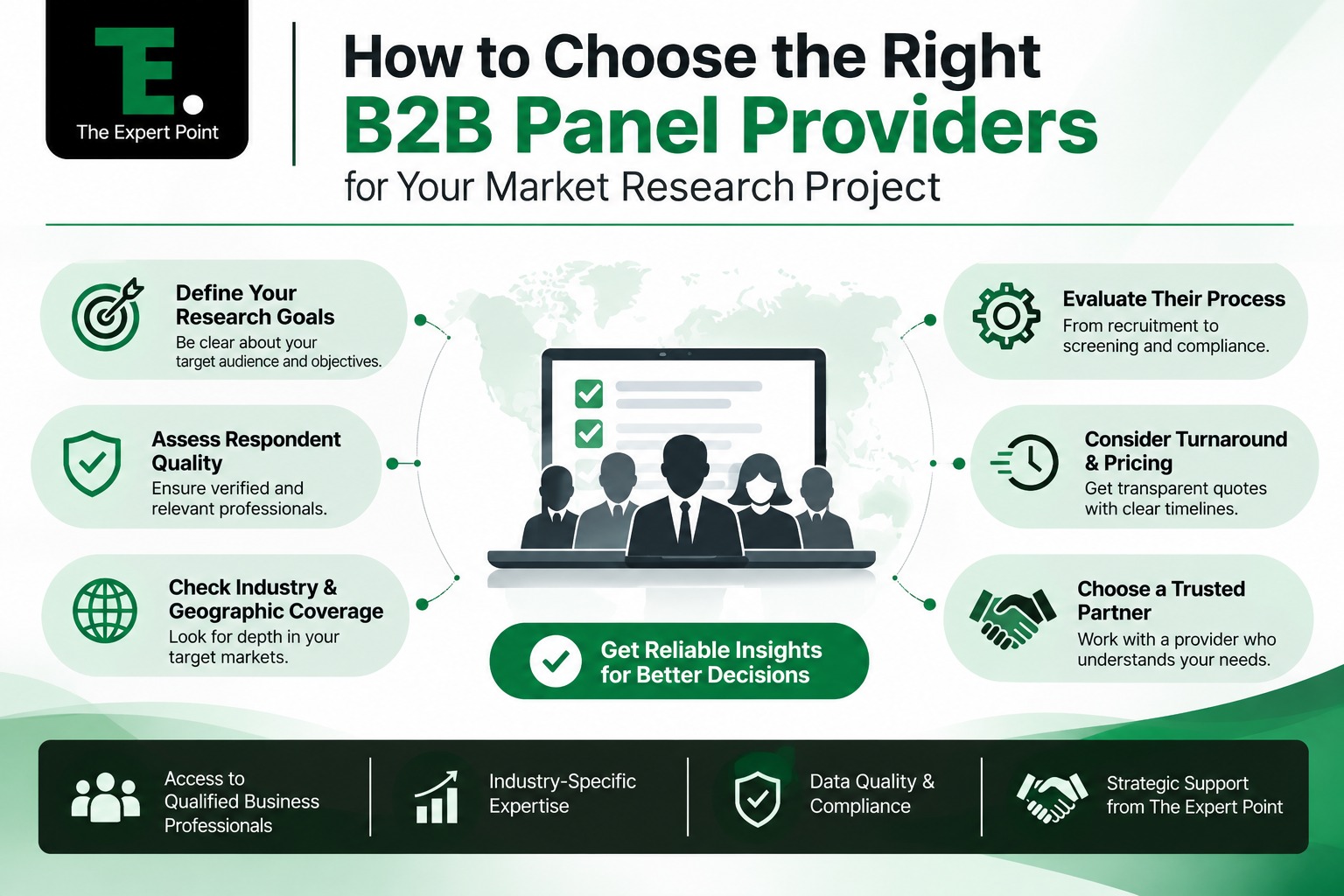
What to evaluate before choosing a B2B panel provider
Before comparing providers, consider these essential factors:
- Does the provider understand your research objectives and target audience?
- Can it reach relevant business professionals and decision-makers?
- How does it verify respondents’ professional backgrounds?
- Does it have experience in your industry and target geography?
- Can it recruit respondents for specialised or hard-to-reach audiences?
- Does it conduct project-specific respondent screening?
- Can it support both B2B and B2C primary research?
- Does it follow appropriate data privacy and research compliance practices?
- Can it deliver the required sample within your timeline?
- Is its pricing transparent, including recruitment and screening costs?
Why choosing the right B2B panel provider matters
B2B market research often involves audiences that are difficult to reach through conventional survey channels. Unlike consumer research, where respondents can be recruited based on general demographic characteristics, B2B research requires specific professional backgrounds, industry knowledge and purchasing responsibilities.
For instance, a company researching industrial automation may need responses from plant managers, engineering heads, production directors and procurement professionals. Reaching general business respondents will not provide the information needed to assess purchasing decisions or operational requirements.
An unsuitable panel can lead to several problems:
- Responses from people outside the target industry.
- Participants without relevant decision-making authority.
- Inaccurate or outdated professional information.
- Low response rates among specialised audiences.
- Delays caused by repeated recruitment.
- Research findings that do not represent the intended business population.
The quality of your research depends heavily on the people providing the information. Selecting a provider with suitable respondent recruitment and screening capabilities helps reduce these risks and improves the usefulness of the findings.
Define your target audience before comparing providers
The first step is to establish exactly who needs to participate in your research. A broad requirement such as “we need business professionals for a technology survey” does not give a provider enough information to identify suitable respondents.
Instead, define the target audience using specific criteria.
For example:
Research objective: Understand the adoption of cloud-based enterprise software among mid-sized businesses.
Target respondents:
- Chief Information Officers (CIOs).
- IT directors and managers.
- Chief Technology Officers (CTOs).
- Enterprise software procurement managers.
- Business owners responsible for technology investments.
Additional screening criteria:
- Industry and company size.
- Current job title and responsibilities.
- Years of professional experience.
- Involvement in software purchasing decisions.
- Geographic location.
- Experience with the technology being researched.
These details help providers understand the type of respondents required and assess whether they can recruit an appropriate sample.
A clearly defined audience also makes it easier to compare multiple B2B panel providers using the same research brief.
Evaluate respondent quality and verification processes
Respondent quality is one of the most important factors when selecting a B2B panel provider. A professional title or company name alone does not establish whether someone is qualified to participate in a survey.
Providers should have a clear process for checking professional backgrounds and confirming that respondents meet the project’s eligibility requirements.
Ask the provider:
- How do you verify a respondent’s current or previous employment?
- Are job titles and professional responsibilities checked?
- Do you confirm respondents’ industry experience?
- How do you identify duplicate or fraudulent survey participation?
- Are respondents screened separately for each project?
- How do you handle participants who provide inconsistent answers?
For specialised research, verification should go beyond basic demographic or professional information.
For example, a survey about pharmaceutical distribution may require participants who have direct experience in pharmaceutical procurement, wholesale distribution or supply chain management.
A respondent who simply works in the healthcare sector may not have the relevant knowledge.
Check industry and geographic coverage
A provider’s ability to recruit suitable respondents depends on its industry coverage and geographical reach.
Some research projects require a broad cross-section of business professionals, while others focus on a particular sector, job function or country.
Before selecting a provider, examine its experience across the industries relevant to your project.
These may include:
- Healthcare and pharmaceuticals.
- Chemicals and materials.
- Information technology and communications.
- Energy and sustainability.
- Industrial and manufacturing.
- Automotive and aviation.
- Financial markets.
- Education.
- FMCG and e-commerce.
- Media and entertainment.
Geographic coverage is equally important. A project involving technology purchasing behaviour in the United States, for example, may require IT decision-makers from different company sizes and regions.
Ask potential providers whether they can recruit respondents in your target countries, manage local research requirements and coordinate projects across time zones.
Do not rely only on claims of global coverage. Ask for examples of comparable research projects and evidence of their ability to reach the specific professional audience you need.
Understand the provider's respondent recruitment process
Recruitment is particularly important when your research involves specialised professionals or decision-makers who are not easily accessible through standard survey panels.
A capable provider should explain where respondents come from, how they are approached and how their suitability is assessed.
Depending on the research requirement, recruitment may involve:
- Existing respondent databases.
- Professional and industry networks.
- Targeted outreach to relevant professionals.
- Industry associations and specialist communities.
- Referrals and additional recruitment channels.
For example, if your project requires interviews with senior executives from the automotive manufacturing sector, a general survey panel may not be sufficient.
The provider may need to conduct targeted recruitment to identify professionals with experience in manufacturing operations, procurement, supply chain management or technology adoption.
Ask whether the provider can recruit outside its existing respondent pool when necessary.
The ability to source specialised respondents is often more valuable than having access to a large database that does not match your requirements.


Examine project-specific screening methods
Respondent screening determines whether the people recruited for your research actually qualify to participate.
A good screening process should be based on the project brief rather than relying entirely on information collected during initial registration.
For example, consider a survey examining how companies select enterprise cybersecurity solutions.
The provider may need to establish whether respondents:
- Work in an organisation that uses enterprise cybersecurity solutions.
- Participate in technology procurement decisions.
- Have knowledge of their company’s cybersecurity requirements.
- Understand the factors influencing vendor selection.
- Have relevant professional experience.
These questions help establish whether the respondent can contribute useful information.
Before engaging a provider, ask whether you can review its screening questionnaire, whether disqualified respondents are excluded and how screening quality is monitored.
You should also establish whether the provider can share sample respondent profiles or anonymised recruitment information before the survey begins.
Compare the research methods and survey capabilities
Not every B2B research project requires the same approach. Some projects need structured responses from a large sample of professionals, while others require detailed discussions with a smaller group of industry specialists.
A suitable research provider should understand the objective and recommend an appropriate research method.
Common research formats include:
- B2B primary surveys: Structured questionnaires used to collect information from business owners, executives, industry professionals and decision-makers.
- In-depth interviews (IDIs): One-to-one discussions that help researchers understand business challenges, professional experiences and industry practices.
- Computer-Assisted Telephone Interviews (CATI): Telephone-based surveys supported by computer systems for recording responses.
- Computer-Assisted Web Interviews (CAWI): Online surveys conducted through digital platforms.
- Focus Group Discussions (FGDs): Moderated group discussions used to collect opinions and understand different business perspectives.
- Expert consultations: Direct conversations with experienced professionals who can provide specialised knowledge about a particular market or industry.
The research method should match the information you need. Surveys help identify patterns across a respondent group, while interviews provide greater detail about individual experiences and decisions.
If your project requires both measurable responses and detailed explanations, consider a provider that can support multiple research formats.


Review data quality and compliance standards
Collecting responses is only one part of B2B market research. The information must also be handled responsibly, with appropriate checks to maintain research quality and protect participants.
Before selecting a provider, understand its approach to data privacy, respondent consent and research compliance.
Consider asking:
- How is respondent consent obtained?
- What measures are used to protect personal and professional information?
- How are duplicate responses identified?
- Does the provider have a process for detecting suspicious or inconsistent answers?
- How long is respondent information retained?
- Who can access the collected survey data?
- Does the provider follow applicable data protection requirements in the target countries?
For international projects, it is particularly important to understand how respondent information is collected, transferred, stored and processed across different jurisdictions.
You should also clarify whether the provider can supply information about its quality-control procedures and data handling practices.
A provider that can explain these processes clearly gives your research team a better basis for evaluating the reliability of the engagement.
Assess turnaround time and project management
Research timelines can influence the selection of a B2B panel provider, particularly when the findings are required for an upcoming investment decision, market entry assessment or consulting presentation.
However, delivery speed should be considered alongside respondent relevance and data quality.
Before starting a project, establish a realistic timeline for each stage:
- Review of the research brief.
- Finalisation of the target audience.
- Questionnaire and screening criteria development.
- Respondent identification and recruitment.
- Screening and eligibility checks.
- Survey distribution and response collection.
- Data validation and quality checks.
- Delivery of the final research data.
Ask the provider how it handles low response rates, respondent withdrawals and recruitment challenges.
You should also establish whether it can provide progress updates and adjust recruitment efforts if the initial respondent pool does not meet your requirements.
For international research, confirm that the project team can coordinate recruitment and communication across the relevant time zones.


Understand the pricing structure
The cost of B2B panel research depends on several factors, including respondent seniority, industry specialisation, geographical coverage, sample size and survey complexity.
Reaching general business professionals may require fewer recruitment resources than sourcing senior executives or specialists from a narrow industry segment.
When comparing quotations, look beyond the cost per completed survey.
Ask whether the pricing includes:
- Respondent identification and recruitment.
- Professional background verification.
- Project-specific screening.
- Questionnaire programming, where required.
- Survey distribution and response collection.
- Data quality checks.
- Replacement of disqualified respondents.
- Research coordination and project management.
- Final data delivery and reporting.
Also clarify whether there are additional charges for specialised respondents, international recruitment, additional screening or changes to the project scope.
A low-cost panel may appear attractive initially, but if it produces a high number of unsuitable responses, the research team may need to spend more time and money recruiting replacements.
Compare the total cost of completing your research with qualified respondents rather than focusing exclusively on the initial quotation.
B2B panel providers vs. expert networks: Understand the difference
B2B panel providers and expert network firms both help businesses access people with professional or industry experience. However, their research objectives and engagement models are different.
Understanding this distinction will help you choose the right partner.
| Evaluation factor | B2B panel providers | Expert networks |
|---|---|---|
| Primary purpose | Collect business survey responses | Obtain specialised industry knowledge |
| Research format | Structured surveys | Expert calls and interviews |
| Target audience | Business professionals and decision-makers | Experienced executives, operators and specialists |
| Research objective | Identify patterns and measurable responses | Understand industry practices and underlying reasons |
| Sample requirements | Often larger respondent groups | Usually smaller, targeted groups |
| Typical output | Survey data and research findings | Expert insights and consultation outcomes |
For example, a company studying demand for industrial automation may need survey responses from 300 manufacturing professionals to understand adoption trends.
However, if the company wants to understand why manufacturers are delaying automation investments, conversations with experienced plant managers, operations directors and technology specialists may provide more useful information.
In some projects, both approaches are necessary.
A survey can establish the extent of a market trend, while expert interviews can help explain the factors behind it.
The right provider should be able to understand this distinction and recommend a research approach that matches your objectives.
The B2B panel provider evaluation checklist
Before finalising a research partner, use the following checklist to compare providers.
| What to evaluate | Question to ask | What a strong answer looks like |
|---|---|---|
| Target audience | Can you reach our specific business audience? | Clear understanding of the required roles, industries and company profiles. |
| Respondent verification | How do you verify professional backgrounds? | Defined verification and eligibility checks. |
| Industry coverage | Do you have experience in our industry? | Relevant industry experience and comparable projects. |
| Geographic reach | Can you recruit across our target markets? | Demonstrated access to the required countries and regions. |
| Recruitment | How do you source specialised respondents? | Existing networks combined with targeted recruitment. |
| Screening | Is screening conducted for each project? | Screening criteria aligned with the individual research brief. |
| Data quality | How do you identify unreliable responses? | Defined validation and quality-control procedures. |
| Compliance | How do you handle respondent information? | Clear consent, confidentiality and data protection practices. |
| Research methods | Which survey and interview formats do you support? | Relevant quantitative and qualitative research capabilities. |
| Turnaround | How long will recruitment and data collection take? | Realistic timelines with progress updates. |
| Pricing | What is included in your quotation? | Transparent breakdown of recruitment, screening and research costs. |
| Project management | Who manages the engagement? | A dedicated contact and clear communication process. |
Use the same questions when evaluating multiple providers. This makes it easier to identify differences in their recruitment capabilities, research processes and overall service quality.
Working with The Expert Point for B2B research requirements
At The Expert Point, we support organisations with B2B and B2C primary surveys, expert interviews, focus group discussions and industry-specific research requirements. Our global network includes empanelled subject matter experts across healthcare and pharmaceuticals, chemicals and materials, IT, manufacturing, automotive, FMCG and other sectors. We work with clients to understand their research objectives, identify relevant professionals, screen them against project requirements and coordinate the appropriate research engagement. Where a project requires specialised industry knowledge, our research team can also identify and recruit additional experts beyond the existing network. We focus on providing research support that aligns with the client’s target audience, project scope and timelines, whether the requirement involves business surveys, expert consultations or a combination of both.


Conclusion
Choosing the right B2B panel provider requires more than comparing database sizes, sample availability or survey costs. The provider must understand your research objectives, reach the appropriate business audience and have a reliable process for respondent recruitment, screening and data validation.
Industry experience, geographical coverage, research methods, compliance practices and project management capabilities should all be considered before making a decision.
It is also important to understand whether your project requires a conventional survey panel, specialised industry professionals or direct consultations with experienced experts. Selecting the right research approach can make a significant difference to the relevance and usefulness of your findings.
A well-selected research partner helps you collect information from the right people, understand your target market and make better-informed business decisions.
Looking for the right professionals for your next B2B research project?
Share your research requirements with us. Our team will understand your objectives and work towards identifying suitable industry professionals and research solutions for your project.
Frequently Asked Questions
Consider respondent quality, professional background verification, industry experience, geographic coverage, recruitment capabilities, screening processes, data quality, compliance, pricing and project turnaround time.
B2B panel providers may verify respondents through employment details, job titles, professional responsibilities, industry experience and project-specific eligibility checks to ensure they match the research requirements.
B2B panel providers primarily collect structured survey responses from business professionals to identify measurable patterns. Expert networks connect businesses with experienced professionals through interviews and consultations to obtain specialised industry insights.
They may use existing respondent databases, professional networks, industry associations, targeted outreach and referrals to identify professionals with relevant industry knowledge and decision-making experience.
The cost depends on respondent seniority, industry specialisation, geographic coverage, sample size and survey complexity. Additional costs may include recruitment, professional verification, screening, data validation and project management.