
How Primary Market Research Helps Private Equity Firms Identify Risks That Financial Due Diligence Cannot Reveal
Private equity investment decisions depend on understanding the financial performance, commercial position, and future growth potential of a target company. Financial due diligence provides important information about revenue, profitability, cash flow, working capital, debt obligations, and historical financial performance. However, these figures do not always explain the market conditions that influence a company’s ability to sustain its performance.
A business may report consistent revenue growth while facing declining customer loyalty, increasing competitive pressure, supplier concentration, or changes in purchasing behaviour. Similarly, a target company may operate in a growing industry but struggle to maintain its market position because of pricing pressure, customer dissatisfaction, or operational limitations.
Primary market research helps private equity firms investigate these risks through direct interactions with customers, suppliers, distributors, competitors, and experienced industry professionals. It provides information about commercial conditions that may not be visible in financial statements or management presentations.
This guide explains how primary market research helps private equity firms identify hidden commercial risks, which areas require investigation, what research methods can be used, and how market intelligence consulting supports more informed investment decisions.
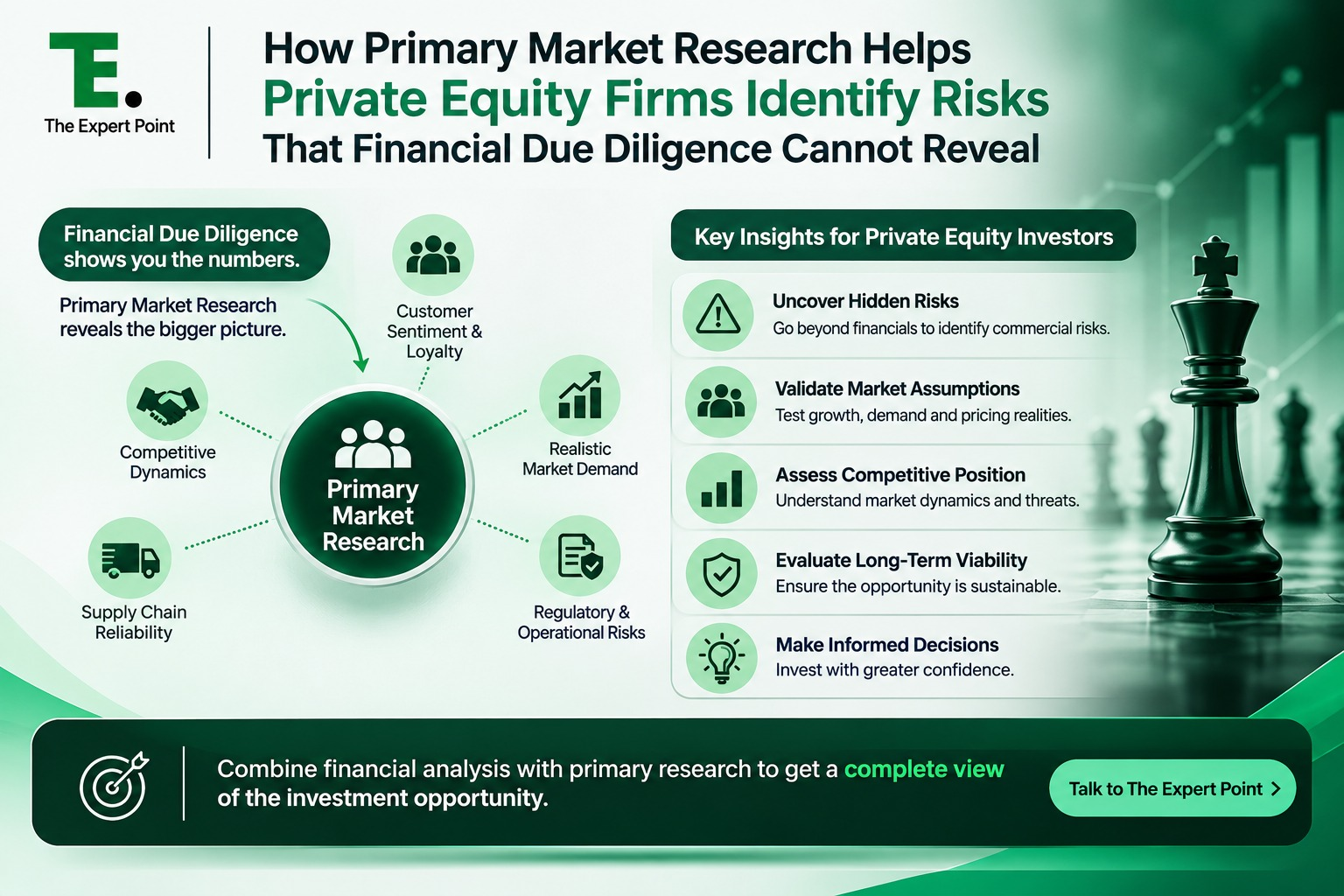
What Primary Market Research Helps Private Equity Firms Identify: The Short Version
Primary market research can help investment teams investigate:
- Customer concentration and dependence on a limited number of buyers.
- Customer satisfaction, retention risks, and switching behaviour.
- Competitive pressure affecting pricing and market share.
- Supplier concentration and supply chain vulnerabilities.
- Revenue sustainability and the quality of existing customer relationships.
- Market demand and the commercial viability of projected growth.
- Regulatory, operational, and industry-specific barriers.
- Management assumptions that require independent validation.
- Changes in purchasing behaviour and emerging market developments.
- Risks that could affect the target company’s future earnings and valuation.
Why Financial Due Diligence Alone May Not Reveal Commercial Risks
Financial due diligence examines the financial position and historical performance of a target company. It helps investors understand whether reported revenue, operating expenses, margins, cash flows, and financial obligations are supported by available records.
However, historical financial performance does not necessarily indicate whether the business can maintain its position in the market.
For example, a manufacturing company may report stable revenue and healthy operating margins. Its financial statements may not reveal that two major customers are considering alternative suppliers because of pricing concerns or product quality issues.
Similarly, a business may show strong sales growth without revealing that it is offering substantial discounts to retain customers or relying on a small number of distributors for market access.
These risks require a different form of investigation.
Primary market research allows investors to examine the commercial relationships and industry conditions behind reported financial performance. Through direct conversations with relevant market participants, investment teams can investigate whether the target company’s revenue streams, customer relationships, pricing strategies, and growth assumptions are sustainable.
Combining financial due diligence with primary research provides a more complete understanding of the business being evaluated.
Identify Customer Concentration and Retention Risks Through Direct Research
Customer concentration is an important consideration in private equity transactions. A company that generates a significant proportion of revenue from a small number of customers may face considerable commercial risk if one or more relationships are discontinued.
Financial records can identify the percentage of revenue contributed by major customers. However, they may not explain the strength of those relationships, the customer’s satisfaction with the supplier, or the likelihood of switching to another provider.
Interviews with existing customers, former customers, procurement managers, and industry specialists can help investigate these issues.
For instance, an investment firm evaluating a pharmaceutical contract manufacturing company may find that a substantial portion of its revenue comes from three large pharmaceutical clients. While the historical revenue contribution appears stable, customer interviews may reveal concerns about production flexibility, quality consistency, delivery timelines, or pricing.
These conversations can help establish:
- Whether customers are satisfied with the target company’s products and services.
- Whether customers are considering alternative suppliers.
- What factors influence supplier retention and switching decisions.
- Whether the target company has long-term contractual relationships or depends on recurring purchase orders.
- How easily customers could transition to competing providers.
- Whether customer relationships depend heavily on individual management personnel.
This information helps investors assess the stability of the customer base rather than relying exclusively on historical revenue figures.
Assess Pricing Pressure and Margin Sustainability
A company’s historical profitability may not accurately reflect its future ability to maintain margins.
Changes in raw material costs, competitor pricing, customer negotiations, procurement policies, and alternative products can affect the prices a business can charge.
Financial due diligence can identify historical changes in gross margins and operating profitability. However, it may not explain why customers are demanding lower prices or how competitors are influencing commercial negotiations.
Primary research helps investigate these market-level factors.
Consider a private equity firm evaluating an industrial equipment manufacturer. The company may demonstrate consistent profitability and project further margin improvements. However, interviews with distributors, procurement professionals, and former sales executives may reveal that competitors are offering lower prices, customers are negotiating longer payment terms, and after-sales service costs are increasing.
Research can help investors understand:
- How customers compare competing suppliers.
- Whether price increases are accepted by the market.
- How frequently competitors offer discounts.
- Whether procurement teams are prioritising cost reduction.
- How raw material cost changes affect supplier negotiations.
- Whether the target company has pricing power based on product differentiation or customer relationships.
These insights help investment teams evaluate whether projected margins are commercially achievable.
Investigate Supplier Concentration and Supply Chain Vulnerabilities
Supplier concentration can expose a business to procurement disruptions, cost fluctuations, production delays, and reduced bargaining power.
A target company may appear financially stable while depending on a limited number of suppliers for critical materials, components, or services.
Financial due diligence can examine supplier payments, procurement expenses, and historical cost movements. However, it may not fully explain the availability of alternative suppliers, supplier reliability, or the difficulty of replacing a critical vendor.
For example, an investment team evaluating a lithium-ion battery component manufacturer may discover that the company relies heavily on a small group of suppliers for specialised raw materials.
Interviews with procurement professionals, supply chain executives, industry specialists, and former operations heads can help establish:
- Whether alternative suppliers are available.
- How easily critical materials can be sourced.
- Whether supplier switching requires technical approvals.
- How procurement costs respond to changes in market demand.
- Whether geopolitical or regulatory developments could affect sourcing.
- Whether the target company has sufficient bargaining power with suppliers.
This information helps investors assess supply chain dependencies that could affect production capacity, operating costs, and future revenue.
Validate Revenue Quality Through Customer and Distributor Interviews
Revenue growth is an important consideration during investment evaluation, but the underlying sources of that growth require careful examination.
A company may report increasing sales because of new customer acquisition, higher order volumes, product expansion, price increases, or improved distribution coverage. However, not all revenue growth has the same level of sustainability.
For example, a consumer goods company may report strong revenue growth due to expansion into new distribution territories. Interviews with distributors and retailers may reveal that sales are being supported by promotional discounts, channel incentives, or temporary inventory accumulation rather than consistent consumer demand.
Primary market research can help investigate:
- Whether customers are placing repeat orders.
- Whether distributors are actively promoting the company’s products.
- Whether sales growth is driven by genuine end-user demand.
- Whether customers are purchasing more because of temporary discounts.
- Whether distributors are experiencing inventory accumulation.
- Whether new customer relationships are likely to generate recurring revenue.
Understanding these factors helps private equity firms distinguish between sustainable commercial growth and revenue that may be difficult to maintain.


Identify Competitive Threats That Could Affect Future Market Position
A target company may hold a strong market position today but face competitive threats that could weaken its position over the investment holding period.
Public competitor information can reveal product portfolios, geographical presence, financial performance, and announced expansion plans. However, it may not explain how customers perceive competing products or why they are changing suppliers.
Customer interviews, distributor discussions, and consultations with former industry executives can provide additional perspectives.
For instance, an investment firm evaluating a speciality chemicals manufacturer may find that the company has established relationships with major industrial customers. However, discussions with industry participants may indicate that competing manufacturers are introducing technically comparable products at lower prices.
Research can help identify:
- Competitors gaining customer accounts.
- Changes in customer supplier preferences.
- Alternative products replacing existing solutions.
- New entrants with lower production costs.
- Changes in distribution and after-sales service capabilities.
- Competitor investments in manufacturing capacity or technology.
- Barriers that protect the target company’s existing market position.
These findings help investors evaluate whether the target company’s competitive advantages are likely to remain sustainable.
Examine Market Demand and the Realistic Potential for Growth
A company operating in a growing industry does not automatically have the ability to capture that growth.
Industry forecasts may indicate increasing demand, but actual commercial opportunities depend on customer requirements, purchasing budgets, supplier qualifications, geographical access, and competitive conditions.
For example, a private equity firm evaluating a healthcare technology company may identify strong projected growth in the medical robotics market. However, interviews with hospital administrators, healthcare procurement professionals, and medical technology specialists may reveal that adoption is restricted by equipment costs, infrastructure requirements, surgeon training, and regulatory approvals.
Primary market research can help investors understand:
- Which customer segments are actively purchasing.
- Whether demand is concentrated in specific geographical markets.
- What factors influence purchasing decisions.
- Whether customers have sufficient budgets for adoption.
- Which product capabilities are required to win new contracts.
- Whether industry growth is translating into actual purchasing activity.
- What barriers could restrict the target company’s expansion.
This helps investment teams assess the addressable market available to the business rather than relying solely on broad industry growth estimates.


Investigate Operational Risks Through Industry Participants
Operational risks may affect a company’s ability to fulfil orders, maintain product quality, expand production, and deliver consistent customer service.
Some operational weaknesses become visible in financial performance only after they have affected costs, revenue, or profitability. Primary research can help identify these issues earlier.
For example, a private equity firm assessing an industrial manufacturing business may find that its production capacity is sufficient based on management estimates. However, interviews with former plant managers, equipment suppliers, and industry specialists may reveal maintenance limitations, skilled labour shortages, or dependence on specialised machinery.
Industry participants can help investigate:
- Production bottlenecks and capacity utilisation.
- Dependence on specialised equipment or technical personnel.
- Quality control and product reliability concerns.
- Manufacturing process limitations.
- Logistics and distribution constraints.
- Operational challenges associated with expansion.
- Industry-specific certification and compliance requirements.
Such information allows investors to understand whether the target company’s operating model can support its projected growth.
Assess Regulatory and Industry Risks Before Making an Investment
Regulatory changes can affect operating costs, market access, product approvals, manufacturing requirements, and the commercial viability of certain business activities.
These risks are particularly important in sectors such as healthcare, pharmaceuticals, financial services, chemicals, energy, and automotive manufacturing.
A target company may currently operate within an established regulatory framework, but upcoming changes could require additional investment or restrict certain commercial activities.
For example, an investor evaluating a pharmaceutical manufacturing business may need to understand how changes in quality standards, manufacturing approvals, environmental requirements, and regulatory inspections could affect production and customer relationships.
Interviews with former regulatory affairs professionals, industry executives, compliance specialists, and technical experts can help investigate:
- Upcoming regulatory developments.
- Changes in industry certification requirements.
- Potential compliance-related operating costs.
- Restrictions affecting manufacturing or distribution.
- Regulatory approval timelines.
- Risks associated with entering new geographical markets.
These perspectives can help investors identify regulatory exposure that requires further investigation during the transaction process.


Identify Management Assumptions That Require Independent Validation
Investment decisions often involve evaluating management forecasts, growth plans, expansion strategies, and commercial projections.
While management presentations provide important information about the target company’s future plans, the assumptions supporting those plans should be examined independently.
For example, a target company may project substantial revenue growth based on expansion into new geographical markets. However, interviews with distributors, customers, and industry specialists may reveal that the company lacks the distribution relationships, product certifications, or customer access required to achieve those projections.
Independent research can help test:
- Whether projected customer acquisition is achievable.
- Whether new geographical markets offer sufficient demand.
- Whether pricing assumptions reflect actual industry conditions.
- Whether competitors can respond to the company’s expansion.
- Whether additional infrastructure or investment will be required.
- Whether management’s growth expectations are consistent with market conditions.
This process allows investors to distinguish between commercially supported growth assumptions and projections that require additional validation.
How The Expert Point Supports Primary Market Research for Private Equity Firms
At The Expert Point, we help private equity firms, management consulting companies, and corporate strategy teams connect with relevant subject matter experts (SMEs) for their commercial due diligence and investment research requirements. Through our global network of 50,000+ experts, we identify and screen experienced professionals based on specific project briefs, industry knowledge, functional responsibilities, and research objectives. Our network includes industry specialists, former executives, senior professionals, customers, suppliers, and other relevant market participants who can provide valuable perspectives on a target company’s commercial position and market environment. Our services include expert calls, customer and supplier interviews, B2B and B2C surveys, and focus groups. We aim to provide the first screened expert profiles within 12 to 24 hours, helping investment teams access relevant industry insights within demanding project timelines. From identifying the right subject matter experts to coordinating research engagements, scheduling, and compliance processes, we support investment teams in gathering the primary market insights needed to assess potential risks and make informed decisions.
Primary Market Research Checklist for Private Equity Due Diligence
Before completing a commercial assessment, investment teams can use this checklist to review important areas of potential exposure.
| Assessment area | Key questions to investigate |
|---|---|
| Customer concentration | Does the company depend heavily on a small number of customers? |
| Customer retention | Are major customers satisfied, and are they considering alternative suppliers? |
| Pricing | Can the company maintain its current pricing and margins? |
| Revenue quality | Is growth supported by recurring demand and repeat purchases? |
| Competition | Are competitors gaining market share or offering better alternatives? |
| Supplier dependency | Does the business rely on a limited number of critical suppliers? |
| Market demand | Is the projected demand commercially accessible? |
| Operations | Are there production, capacity, or skilled labour constraints? |
| Regulation | Could regulatory developments affect business operations? |
| Management assumptions | Are growth projections supported by independent market evidence? |
| Investment implications | Have identified risks been incorporated into the investment assessment? |
Triangulate Primary Research Findings With Financial and Secondary Research
Primary market research should not be treated as a replacement for financial due diligence or secondary research. Its purpose is to provide additional evidence that helps investors understand the commercial factors behind financial performance.
A more reliable assessment combines different sources of information.
For example, when evaluating an automotive components manufacturer, an investment team may use:
- Financial records to examine revenue concentration and profitability.
- Customer interviews to understand supplier satisfaction and switching risks.
- Procurement interviews to investigate pricing pressure and sourcing requirements.
- Distributor discussions to assess market access and competitor activity.
- Industry experts to evaluate technological changes and future demand.
- Secondary research to compare findings with industry forecasts and market data.
Where findings differ, investors should investigate the reasons rather than automatically accepting one source of information.
For instance, if management forecasts strong customer retention but interviews reveal increasing dissatisfaction among major buyers, the discrepancy requires further examination.
This process of triangulation helps investment teams identify inconsistencies, challenge assumptions, and develop a more balanced assessment of the target company’s commercial position.


Select the Right Research Participants for Private Equity Due Diligence
The quality of primary market research depends heavily on the relevance of the people selected for the engagement.
A senior professional may have considerable industry experience but may not necessarily be familiar with the specific commercial issue under investigation.
Research teams should therefore select participants according to their previous responsibilities, industry exposure, functional expertise, and geographical experience.
For example, when assessing a pharmaceutical contract manufacturing business, an investment team may require:
Former pharmaceutical executives: To understand industry structure, competitive positioning, and outsourcing trends.
- Procurement heads: To examine supplier selection, pricing negotiations, and purchasing requirements.
- Former customers: To assess service quality, supplier relationships, and switching considerations.
- Manufacturing specialists: To investigate production capacity, quality requirements, and operational constraints.
- Regulatory professionals: To understand compliance requirements and potential regulatory changes.
Before interviews are conducted, research teams should establish the specific investment questions, required professional backgrounds, target companies, geographical coverage, and screening criteria.
Experts should be assessed against the research brief, with relevant professional experience and potential conflicts identified before their profiles are presented.
All interactions must also comply with applicable confidentiality obligations and restrictions on material non-public information.
Turn Primary Research Findings Into Investment Risk Assessments
Collecting interviews and survey responses is not the final objective. The findings must be connected to the investment questions that matter.
For example, if customer interviews reveal that several major buyers are considering alternative suppliers, the investment team should investigate the potential impact on customer retention and future revenue.
Similarly, if supplier interviews reveal limited availability of critical raw materials, investors may need to reconsider production expansion assumptions and projected operating costs.
Research findings should be evaluated against specific investment considerations:
- Revenue sustainability and customer retention.
- Customer and supplier concentration.
- Pricing power and margin stability.
- Competitive positioning and market share.
- Market demand and growth potential.
- Supply chain and operational dependencies.
- Regulatory exposure and compliance requirements.
- Feasibility of management’s expansion plans.
The objective is to determine whether the research supports existing assumptions, identifies additional risks, or requires changes to the investment thesis.
Primary research does not eliminate investment uncertainty. It helps investment teams understand where uncertainty exists and what further investigation may be necessary before committing capital.


Conclusion
Financial due diligence provides an essential understanding of a target company’s historical performance, financial position, and profitability. However, it cannot independently explain every commercial factor that may influence future business performance.
Customer relationships, purchasing behaviour, pricing pressure, supplier dependencies, competitive developments, and industry-specific challenges require direct investigation through primary market research.
By engaging with customers, suppliers, distributors, former executives, and relevant industry professionals, private equity firms can identify risks that may not be apparent from financial records or management projections. When these findings are evaluated alongside financial analysis and secondary research, investors gain a more complete understanding of the target company’s commercial position.
Before committing capital, investment teams need to understand not only how a business has performed financially, but also whether the market conditions supporting that performance are likely to continue. Primary market research helps bridge this gap, supporting more informed due diligence and investment decisions.
Looking to Identify Commercial Risks Before Your Next Investment?
Share your research requirements with The Expert Point. We help private equity firms and consulting teams connect with screened industry professionals who can provide relevant perspectives on customers, competitors, suppliers, and market conditions.
Frequently Asked Questions
Primary market research helps investors investigate commercial risks that may not be visible in financial statements, including customer retention, pricing pressure, supplier dependencies, competitive threats, and market demand.
Financial due diligence examines historical financial performance and financial risks, while primary research investigates the commercial conditions influencing that performance. Combining both provides a more complete assessment of the target business.
Depending on the investment, relevant professionals may include former industry executives, procurement heads, customers, distributors, suppliers, manufacturing specialists, and regulatory professionals.
Yes. Customer interviews can reveal dissatisfaction, switching intentions, pricing concerns, alternative supplier preferences, and changes in purchasing behaviour that may affect future revenue.
Expert networks help investment teams identify and connect with professionals who have relevant industry and functional experience. These consultations can provide first-hand perspectives for evaluating market conditions, competitive positioning, and commercial risks.
It helps investors independently test management assumptions, validate market demand, identify commercial vulnerabilities, and evaluate whether projected growth is supported by actual industry conditions.