
Oilfield Services Valuation: How to Test Utilization, Day Rates and Margin Resilience Through Expert Interviews
Valuing an oilfield services company requires more than reviewing historical revenue, EBITDA and projected cash flows. A business may report strong earnings during a period of high drilling activity, yet struggle to maintain profitability when customer budgets tighten, equipment utilization falls or contract rates come under pressure. For investors and consulting firms, the challenge is to determine whether current financial performance reflects sustainable business strength or favourable market conditions. Insights from Oil and gas industry experts can help assess these risks and determine whether a company’s earnings are sustainable across different market conditions.
This distinction is particularly important in commercial due diligence for mergers and acquisitions, private equity investments and strategic expansion. Oilfield services businesses operate across different service lines, including drilling, well completion, pressure pumping, equipment rental, offshore support, maintenance and well intervention. Each has its own cost structure, customer relationships and exposure to fluctuations in upstream spending.
Expert interviews provide an additional source of evidence to test the assumptions behind a valuation. Conversations with former executives, procurement leaders, operations managers and other experienced professionals can help investors understand how a company performs under actual market conditions.
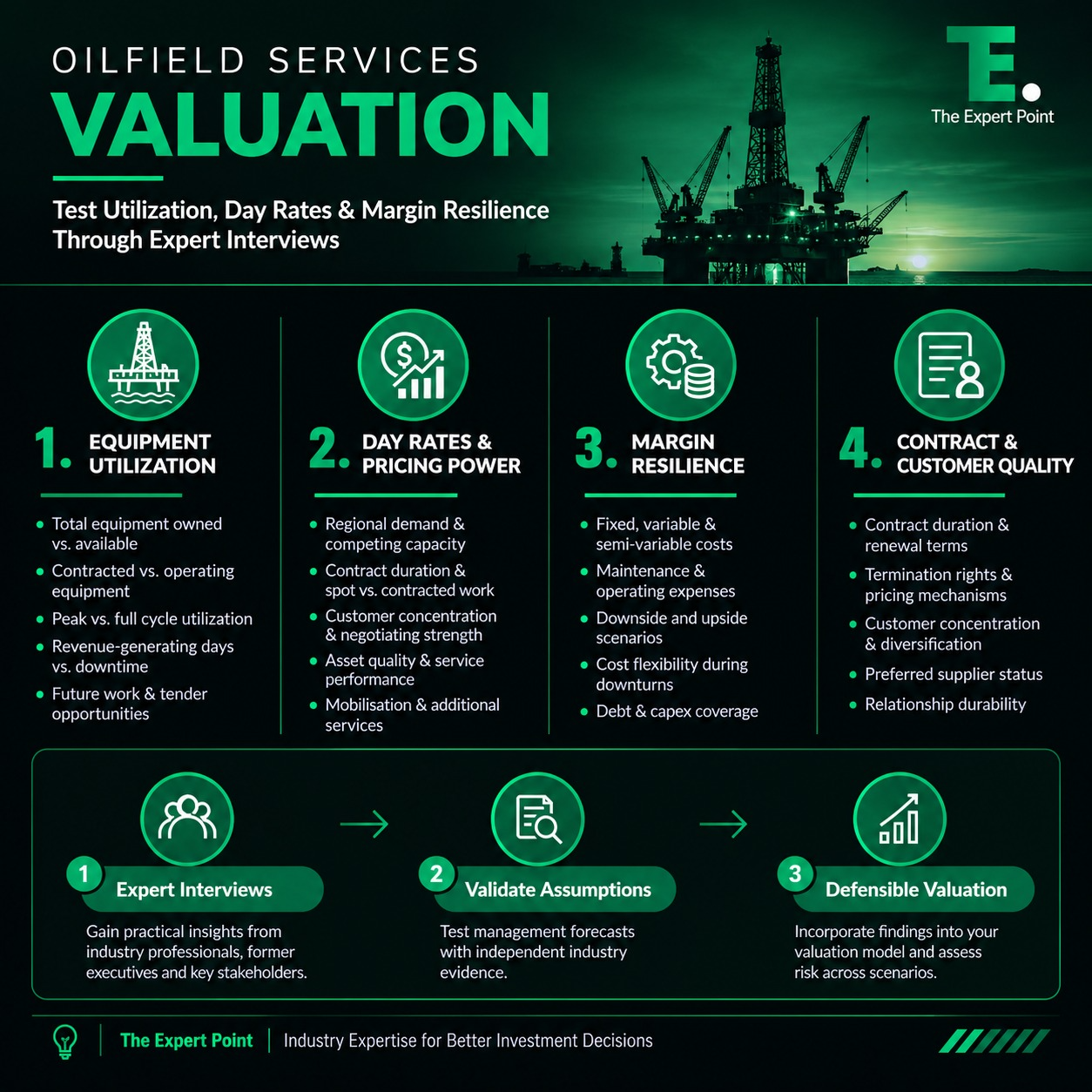
What to Evaluate: The Short Version
A valuation assessment should examine the commercial assumptions that determine whether an oilfield services company’s earnings can be sustained across different market conditions.
Key questions include:
- Can the company maintain its equipment utilization levels?
- Are its day rates commercially sustainable?
- Can its operating margins withstand weaker demand or higher costs?
- Does reported utilization reflect actual revenue-generating activity?
- Are current day rates supported by lasting pricing power or temporary market conditions?
- Can the company manage fixed costs and maintenance requirements during a downturn?
- Does its contract backlog provide reliable revenue visibility?
- Are customer relationships durable, and is revenue sufficiently diversified?
- Are management’s forecasts supported by independent industry evidence?
- How sensitive is the valuation to changes in utilization, pricing and operating costs?
A structured approach helps investors identify the assumptions that could materially affect earnings and determine whether the proposed acquisition price adequately reflects the risks involved.
Why Oilfield Services Valuation Requires Primary Research
Oilfield services companies often operate in cyclical markets. Their financial performance depends on exploration and production budgets, drilling programmes, commodity prices, equipment availability, contract structures and regional operating conditions.
A company reporting high EBITDA margins may benefit from temporary shortages of equipment or unusually strong demand. Another business with lower current margins may have newer equipment, stronger customer relationships or contracts that offer more stable revenue over time.
Historical financial statements do not always explain these differences. They show what happened, but may not reveal why customers awarded contracts, how competitors are pricing similar services or whether the current workload can be sustained.
For investors, three questions are particularly important:
- Can the company maintain its equipment utilization levels?
- Are its day rates commercially sustainable?
- Can its operating margins withstand weaker demand or higher costs?
Oil and gas industry experts can help address these questions by providing practical perspectives on customer purchasing decisions, operating constraints, competitive behaviour and changes in market demand. Their input should be assessed alongside financial records, contracts, operational data and other independent evidence.
Testing Equipment Utilization and Revenue Sustainability
Equipment utilization is one of the most important drivers of profitability for many oilfield services businesses. Drilling rigs, pressure pumping fleets, workover units and specialised equipment require substantial investment, maintenance and personnel. When equipment remains idle, the company may continue to incur depreciation, storage, maintenance and other costs without generating corresponding revenue.
However, utilization figures must be interpreted carefully. Companies may calculate utilization using different measures, including available fleet capacity, contracted equipment, operational days or revenue-generating days. A reported utilization rate is meaningful only when the underlying definition is understood.
What investors should examine
A valuation assessment should distinguish between:
- Total equipment owned and equipment available for deployment.
- Equipment contracted to customers and equipment actually operating.
- Utilization during peak periods and utilization across a complete market cycle.
- Revenue-generating days and days lost to maintenance, mobilisation or customer delays.
- Contracted future work and opportunities that remain subject to tender or customer approval.
This analysis helps determine whether reported revenue reflects sustained demand or a temporary increase in activity.
How expert interviews help
Interviews with former and current Operation Managers, Drilling supervisors and customer representatives can help explain whether a company’s utilization assumptions are realistic.
For example, an oilfield services provider may forecast high utilization based on its current contract backlog. Interviews with relevant industry professionals could reveal that several contracts are approaching expiry, customers are delaying new projects or competitors have recently introduced additional equipment into the market.
These observations do not automatically invalidate management’s forecast. They identify assumptions that require further testing.
Investors should also examine the quality of the equipment fleet. High utilization is less valuable if it results in excessive maintenance costs, frequent downtime or discounted pricing to keep older equipment operating. Conversely, a lower utilization rate may be reasonable for specialised assets that command premium rates when deployed.
The objective is to estimate sustainable utilization, rather than simply carrying the latest reported figure into the financial model.
Assessing Day Rates and Pricing Power
Day rates are another major determinant of revenue and profitability for businesses that charge customers according to equipment or personnel deployment time. They are especially relevant to drilling contractors, offshore support providers and certain equipment rental businesses.
An increase in day rates can improve earnings without requiring a proportionate increase in equipment capacity. However, strong rates during a period of tight supply may decline when operators reduce spending or competing equipment becomes available.
Investors must therefore establish whether the company’s pricing reflects a durable competitive advantage or temporary market conditions.
Key factors affecting day rates
Day rates are influenced by several factors:
- Regional demand for drilling and related services.
- Availability and technical specifications of competing equipment.
- Contract duration and the balance between spot and contracted work.
- Customer concentration and the negotiating strength of major operators.
- Equipment age, reliability, safety performance and service quality.
- Mobilisation costs, contract scope and additional services included in the quoted rate.
Comparisons must account for these differences. A premium offshore rig and a conventional land rig should not be benchmarked using the same rate assumptions without adjusting for their specifications, operating conditions and contract terms.
Examining Contract Backlog and Customer Relationships
A strong contract backlog can support revenue visibility, but the headline value of the backlog does not necessarily indicate the quality of future earnings.
Some contracts may have minimum activity commitments, while others depend on customer requirements. Certain agreements may be cancellable, subject to budget approval or exposed to renegotiation when market conditions change.
Investors should examine contract duration, renewal provisions, termination rights, pricing mechanisms, payment terms and customer concentration.
Customer interviews can provide an independent view of the company’s position within the supply chain. Buyers may explain whether the provider is considered a preferred supplier, whether alternative vendors are available and how service quality affects renewal decisions.
They can also reveal whether customer relationships depend on institutional capabilities or a small number of individual contacts.
A business with several long-standing customers is not necessarily well diversified if most revenue comes from one operator or a single basin. Likewise, a company with a concentrated customer base may still have strong prospects if contracts are durable and switching suppliers involves substantial technical or operational costs.
These distinctions matter when estimating recurring revenue, customer retention and the appropriate valuation multiple.
Selecting the Right Experts for Valuation Interviews
The quality of primary research depends on selecting professionals whose experience matches the assumptions being tested.
A general industry executive may provide useful context, but a drilling operations manager is often better placed to explain fleet utilization. A procurement head may offer a more relevant perspective on contract pricing, while a former commercial director may understand bidding practices and margin pressures.
A well-structured interview programme can include:
- Former company executives: To understand operating models, competitive positioning and historical business performance.
- Operator procurement leaders: To assess supplier selection, pricing, contract renewals and switching behaviour.
- Operations and maintenance managers: To evaluate equipment productivity, downtime and maintenance requirements.
- Industry consultants and market specialists: To examine regional demand, capacity additions and competitive dynamics.
- Customers and distributors: To validate service quality, purchasing criteria and supplier relationships.
Each interview should be designed around specific hypotheses rather than broad questions about the industry.
For example, if an investment thesis assumes that a company can increase utilization by ten percentage points, the research team should investigate the availability of additional work, competing capacity, customer budgets and the operational constraints that could prevent the increase.
Experts should be screened for relevant experience, role history, recency and potential conflicts of interest. Interviews must also respect confidentiality obligations and applicable compliance requirements. Experts should never be asked to disclose confidential customer information, trade secrets or material non-public information.
Findings should be compared across independent sources. Expert opinion is valuable evidence, but it should not replace verified operational and financial data.
Translating Expert Insights into a Defensible Valuation
Expert interviews create the greatest value when their findings change or validate the assumptions used in the valuation model.
The research team should connect each material finding to a financial driver.
If interviews indicate that a company’s equipment utilization forecast is too optimistic, the team can revise projected revenue and assess the impact on EBITDA. If customer feedback suggests that recent day-rate increases are unlikely to persist, the model can incorporate lower renewal rates. If maintenance requirements are higher than management expects, operating costs and capital expenditure forecasts may need adjustment.
These revisions can then be reflected in discounted cash flow analysis, earnings multiples and downside valuation scenarios.
It is also useful to distinguish between findings that affect near-term earnings and those that influence long-term competitive positioning. A temporary decline in drilling activity may affect the next financial year without changing the company’s underlying capabilities. Persistent customer losses, ageing equipment or weak pricing power may indicate a more structural problem.
The final assessment should document the evidence supporting each material assumption, the degree of uncertainty and the sensitivity of the valuation to alternative outcomes.
This approach gives investment committees a clearer basis for deciding whether the proposed acquisition price adequately reflects the risks involved.
Oilfield Services Valuation Checklist
Investors can use the following checklist when assessing an oilfield services company or preparing a commercial due diligence brief.
| What to evaluate | Question to investigate | Evidence to examine |
|---|---|---|
| Equipment utilization | Can the company maintain utilization levels? | Available capacity, operational days, maintenance downtime and contract backlog |
| Day rates | Are current rates commercially sustainable? | Historical rates, regional demand, competing capacity and contract terms |
| Margin resilience | Can margins withstand weaker demand or higher costs? | Fixed and variable costs, maintenance requirements and scenario analysis |
| Contract backlog | Does the backlog provide reliable revenue visibility? | Contract duration, renewal provisions, termination rights and pricing mechanisms |
| Customer relationships | Are customer relationships durable? | Customer concentration, supplier selection, switching costs and renewal decisions |
| Expert selection | Do interviews address the assumptions being tested? | Relevant experience, role history, recency and compliance screening |
| Valuation assumptions | Are financial forecasts supported by independent evidence? | Historical performance, contracts, operational data and expert findings |
Once the research is complete, findings should be incorporated into the valuation model and assessed against alternative operating scenarios. Where evidence is incomplete or contradictory, investors can commission additional research before reaching a conclusion.
Questions to ask industry experts
Interviews should establish how customers evaluate competing providers and what drives actual contract awards.
Useful questions include:
- Have day rates increased because of genuine capacity shortages or temporary demand?
- How do current rates compare with contracts awarded in previous cycles?
- Are customers accepting higher rates for better equipment reliability or service quality?
- How frequently are contracts renegotiated, and what happens when they expire?
- Are suppliers offering discounts, rebates or more favourable terms to win business?
- Which competitors are adding capacity, and how might this affect pricing?
Procurement professionals can explain how buyers compare suppliers, while former commercial executives can provide context on bidding strategies and contract negotiations.
These interviews can help distinguish between headline rates and the effective revenue a company earns after discounts, downtime provisions, mobilisation arrangements and other contractual adjustments.
For valuation purposes, investors should model multiple pricing scenarios rather than assume that recent rate increases will continue indefinitely.
Evaluating Margin Resilience Under Different Market Conditions
EBITDA margin is an important measure of operating profitability, but its sustainability depends on the relationship between revenue, fixed costs and variable expenses.
Oilfield services businesses often have significant fixed operating costs. Equipment depreciation, maintenance infrastructure, specialist personnel and regional facilities may remain necessary even when activity declines. As utilization falls, these costs are spread across fewer revenue-generating days, placing pressure on margins.
At the same time, rising labour costs, spare-parts prices, fuel expenses, insurance premiums and equipment maintenance requirements can reduce profitability even when day rates remain stable.
Understanding the cost structure
A robust assessment should separate fixed, variable and semi-variable costs.
Fixed costs may include certain facility expenses, permanent staff costs and equipment-related overheads. Variable costs may include consumables, some transportation expenses and activity-linked labour. Semi-variable costs can rise in stages as equipment deployment increases.
The exact classification depends on the service line and operating model.
Expert interviews can help investors understand which costs management can realistically reduce during a downturn and which expenses must be maintained to preserve operating readiness.
For example, an operations manager may explain that reducing maintenance expenditure improves short-term cash flow but increases the risk of equipment failures and costly repairs later. A former finance executive may clarify how workforce requirements change with utilization and why cost reductions often lag behind falling revenue.
Such evidence helps investors assess whether forecast margin improvements are operationally achievable.
Stress-testing margin assumptions
Rather than relying on a single forecast, investors should model several scenarios.
Base case: Utilization and day rates remain broadly consistent with normal market conditions, while operating costs rise at an expected rate.
Downside case: Customer activity weakens, contract renewals occur at lower rates and equipment utilization declines. Fixed costs are absorbed across fewer operating days.
Upside case: Demand improves, available equipment tightens and the company secures better contract terms while maintaining operating efficiency.
The assumptions in each scenario should be supported by historical performance, contract data, market information and expert interviews.
A useful test is to determine how much utilization or pricing can decline before EBITDA falls below the level required to support debt obligations, planned capital expenditure or the acquisition valuation.
The results help investors understand not only the company’s expected profitability but also its exposure to adverse market conditions.
How We at The Expert Point Support Oilfield Services Valuation
At The Expert Point, we connect consulting firms, private equity investors, corporate strategy teams and M&A professionals with relevant industry specialists who can help test commercial assumptions during oilfield services valuation. Through our global expert network, we identify and screen former executives, operations managers, procurement professionals and other subject matter experts according to each project’s requirements. We support expert calls, targeted interviews and surveys designed to investigate utilization, day rates, contract durability, customer behaviour and margin resilience. Our approach includes project-specific screening, coordination and compliance procedures, helping clients obtain relevant industry perspectives within demanding project timelines. By connecting clients with professionals who understand the realities of oilfield services, we help strengthen primary research and support more informed investment decisions.
Conclusion
Oilfield services valuation requires a clear understanding of the commercial factors behind reported financial performance. Equipment utilization determines how effectively a company converts its asset base into revenue. Day rates influence pricing power and earnings potential, while cost flexibility and operational efficiency determine how well margins hold up when market conditions weaken.
Expert interviews help investors test these assumptions against the experience of people who understand operator procurement, equipment deployment, contract negotiations and industry competition. When combined with financial analysis, contract reviews and independent market evidence, this research can expose weaknesses in optimistic forecasts and identify businesses with more durable earnings.
For consulting firms, private equity investors and corporate decision-makers, the objective is not simply to estimate what an oilfield services company earns today. It is to establish what it can reasonably earn across different market conditions, and whether that earning potential justifies the valuation.
Looking for Relevant Industry Expertise for Your Next Valuation?
Connect with industry professionals who can help you assess equipment utilization, day rates, contract durability, and margin resilience.
Frequently Asked Questions
The key factors include equipment utilization, day rates, EBITDA margins, contract backlog, customer concentration, maintenance costs, and exposure to oil and gas market cycles. Investors should also assess the company’s competitive position and ability to sustain earnings when demand weakens.
Expert interviews provide insights into customer purchasing behaviour, supplier pricing, equipment demand, contract renewals, and operating costs. Discussions with former executives, procurement leaders, and operations managers help investors test management assumptions and identify commercial risks that may not be evident from financial statements alone.
Equipment utilization determines how effectively a company generates revenue from its available assets. Low utilization can reduce profitability because maintenance, depreciation, and other fixed costs continue even when equipment is idle. Investors should distinguish between contracted capacity, operational utilization, and actual revenue-generating days.
Investors should compare current rates with historical contract rates, regional demand, competing equipment availability, and customer purchasing behaviour. Interviews with procurement professionals and former commercial executives can help establish whether higher rates reflect lasting pricing power or temporary supply constraints.
We connect consulting firms, private equity investors, and corporate strategy teams with relevant oil and gas industry experts. Through expert calls, targeted interviews, and surveys, we help clients investigate equipment utilization, day rates, customer relationships, contract durability, and margin resilience to support better-informed valuation and investment decisions.