
CAWI Surveys to Validate Market Demand During Commercial Due Diligence
Commercial due diligence plays an important role in private equity investments, mergers and acquisitions, and strategic business evaluations. Before investing in a target company, investors need to understand whether its products or services address a genuine market need, whether customers are willing to purchase them, and whether the business can sustain its projected growth.
Financial records and management presentations provide information about historical revenue, profitability, customer relationships, and future business plans. However, they do not always establish whether the market demand behind these figures is sustainable.
A company may report increasing sales while relying on temporary discounts, a limited customer base, or favourable market conditions. Similarly, a target business may operate in a growing industry without having sufficient customer acceptance, distribution capabilities, or competitive advantages to capture the projected opportunity.
Computer-Assisted Web Interviewing (CAWI) provides a structured approach to collecting primary market research data directly from relevant respondents through online surveys. When designed around specific commercial questions, CAWI surveys can help investors assess customer preferences, purchasing behaviour, product adoption, pricing sensitivity, supplier selection, and unmet market needs.
For commercial due diligence, CAWI is particularly useful when investment teams need to evaluate demand across multiple customer segments, industries, or geographical markets.
This guide explains how CAWI surveys help validate market demand during commercial due diligence, which areas investors should investigate, how respondent selection influences research quality, and how The Expert Point supports primary research requirements.
Private equity investment decisions depend on understanding the financial performance, commercial position, and future growth potential of a target company. Financial due diligence provides important information about revenue, profitability, cash flow, working capital, debt obligations, and historical financial performance. However, these figures do not always explain the market conditions that influence a company’s ability to sustain its performance.
A business may report consistent revenue growth while facing declining customer loyalty, increasing competitive pressure, supplier concentration, or changes in purchasing behaviour. Similarly, a target company may operate in a growing industry but struggle to maintain its market position because of pricing pressure, customer dissatisfaction, or operational limitations.
Primary market research helps private equity firms investigate these risks through direct interactions with customers, suppliers, distributors, competitors, and experienced industry professionals. It provides information about commercial conditions that may not be visible in financial statements or management presentations.
This guide explains how primary market research helps private equity firms identify hidden commercial risks, which areas require investigation, what research methods can be used, and how market intelligence consulting supports more informed investment decisions.
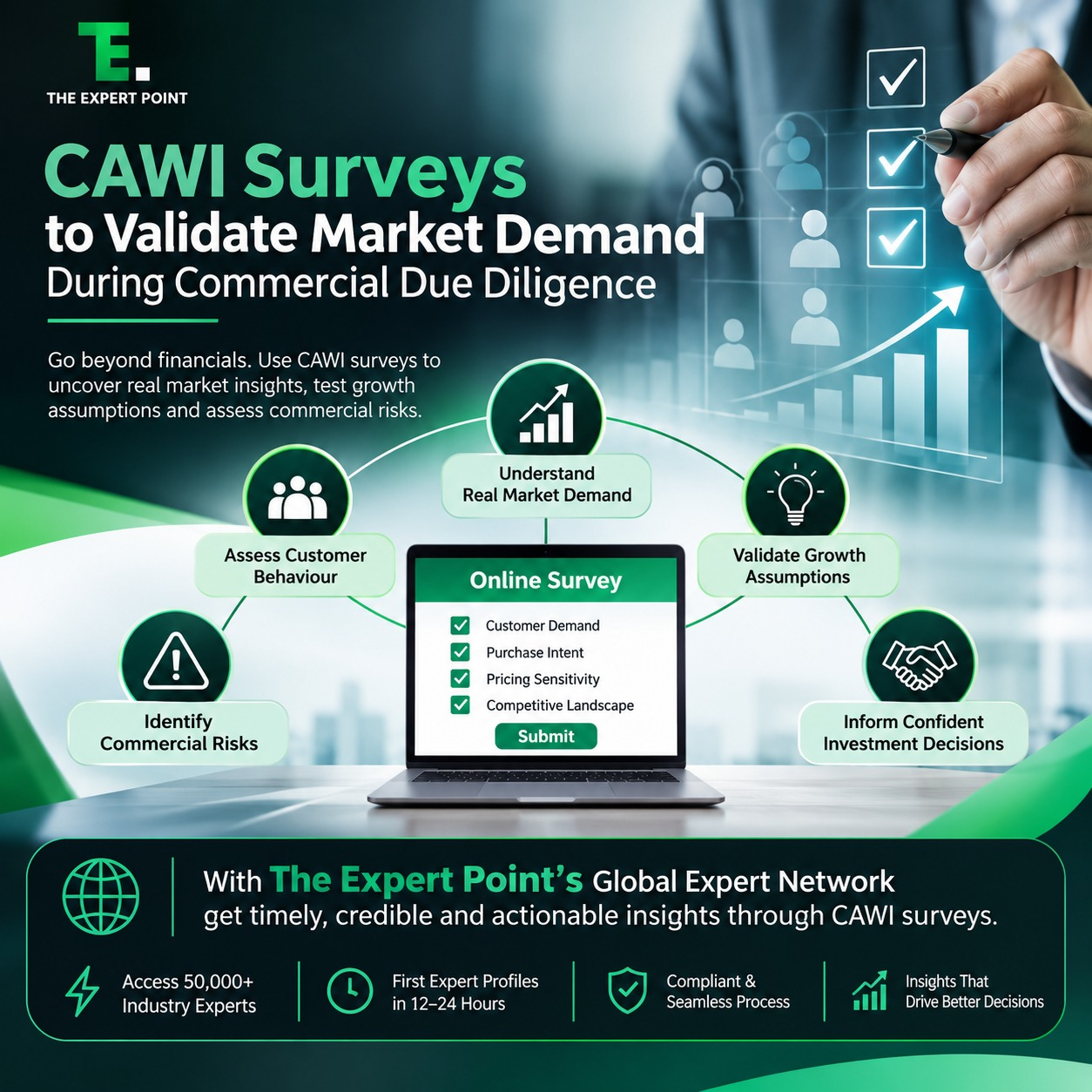
What CAWI Surveys Help Validate During Commercial Due Diligence: The Short Version
CAWI surveys can help private equity firms, consulting teams, and corporate strategy professionals investigate:
- Actual customer demand for a target company’s products or services.
- Purchase intent and willingness to adopt new products or solutions.
- Customer preferences, purchasing criteria, and decision-making processes.
- Pricing sensitivity and willingness to pay.
- Customer satisfaction, retention, and switching behaviour.
- Competitive positioning and preferences for alternative suppliers.
- Demand differences across customer segments and geographical markets.
- Barriers affecting product adoption and purchasing decisions.
- Unmet customer needs and potential market opportunities.
- Whether management’s market growth assumptions are supported by customer evidence.
Why Market Demand Requires Independent Validation During Commercial Due Diligence
Market demand is one of the most important factors influencing a target company’s future revenue potential. Investors need to determine whether the business operates in a market with sufficient demand and whether its products or services can attract and retain customers.
However, industry growth forecasts and historical sales figures do not necessarily establish the commercial viability of a particular business.
For example, a company manufacturing enterprise software may report strong revenue growth and present plans to expand into new customer segments. Its management may attribute this growth to increasing demand for digital transformation solutions.
However, interviews and surveys with enterprise buyers may reveal that purchasing decisions are being delayed because of implementation costs, integration difficulties, cybersecurity requirements, or budget restrictions. Some customers may also be evaluating competing software providers.
These findings can change how investors assess the company’s growth potential.
CAWI surveys allow investment teams to collect structured feedback from relevant market participants and examine whether the demand assumptions supporting a target company’s valuation are consistent with actual customer behaviour.
Unlike relying exclusively on management estimates, primary survey research provides an additional source of evidence from people involved in purchasing decisions, product usage, and supplier selection.
Assess Actual Customer Demand Beyond Industry Growth Forecasts
An expanding industry does not guarantee that every company operating within it will benefit from increasing demand.
Investors must establish whether the target company’s specific products or services address a market requirement and whether potential customers are actively considering purchasing them.
CAWI surveys can help investigate demand across defined customer groups by collecting information about current purchasing activity, product requirements, future purchasing plans, and adoption barriers.
For instance, a private equity firm evaluating a medical equipment manufacturer may identify strong projected growth in the hospital automation market. However, surveys involving hospital administrators, procurement professionals, and healthcare decision-makers may reveal that adoption remains limited because of high equipment costs, infrastructure requirements, and staff training needs.
The research can help establish:
- Whether potential customers are currently purchasing similar products.
- Which customer segments demonstrate the strongest demand.
- Whether customers intend to increase purchasing over the next few years.
- Which product features influence purchasing decisions.
- Whether customers have allocated budgets for adoption.
- What factors prevent interested buyers from completing purchases.
- Whether demand is concentrated in specific geographical markets.
This information helps investors distinguish between broad industry growth and demand that the target company can realistically access.
Measure Purchase Intent and the Likelihood of Product Adoption
Purchase intent provides an indication of whether potential customers are considering buying a product or service within a defined period.
For businesses introducing new products, entering new markets, or targeting additional customer segments, understanding purchase intent is important for assessing future commercial opportunities.
However, purchase intent should not be treated as a direct forecast of actual sales. A respondent may express interest in a product without having the budget, authority, or immediate requirement to purchase it.
CAWI surveys can examine purchase intent alongside other factors that influence actual buying decisions.
Consider an investment firm assessing a SaaS company that plans to expand its customer base among mid-sized manufacturing businesses.
A CAWI survey targeting IT heads, operations managers, and business decision-makers could investigate:
- Whether respondents currently use competing software solutions.
- Whether their existing systems meet operational requirements.
- Whether they intend to adopt a new solution.
- What factors could trigger a purchasing decision.
- Whether they have an approved technology budget.
- What implementation challenges could delay adoption.
- Which vendors they currently consider.
- What features would justify switching to a different provider.
By examining these factors together, investors can assess whether the target company’s proposed customer acquisition strategy reflects actual market requirements.
Evaluate Pricing Sensitivity and Customer Willingness to Pay
A target company may have a product that customers consider valuable, but its ability to convert demand into revenue depends partly on whether buyers are willing to pay the proposed price.
Pricing assumptions are particularly important when evaluating businesses planning to introduce new products, increase prices, enter premium market segments, or expand into price-sensitive geographical markets.
Financial due diligence can establish historical selling prices and revenue trends. However, it may not explain how customers respond to alternative pricing levels or whether competitors offer more attractive commercial terms.
CAWI surveys can help investigate these questions through structured pricing research.
For example, an investor evaluating an industrial automation solutions provider may want to understand whether manufacturers would pay a premium for automation systems that improve production efficiency and reduce labour requirements.
Survey questions can examine:
- Acceptable price ranges for specific products or services.
- Customer willingness to pay for additional features.
- Sensitivity to price increases.
- Preferences for subscription-based or one-time payment models.
- Perceived value compared with competing solutions.
- Budget limitations and purchasing approval requirements.
- Price differences across customer segments.
Where appropriate, research teams can use techniques such as price sensitivity measurement and discrete choice experiments to examine how customers evaluate different product and pricing combinations.
These findings help investors assess whether management’s revenue and margin assumptions are supported by customer purchasing preferences.
Identify Customer Preferences and Competitive Positioning
A target company may have an established customer base, but investors should understand why customers choose its products over competing alternatives.
Product quality, pricing, technical capabilities, customer service, distribution coverage, brand reputation, and supplier relationships can all influence purchasing decisions.
CAWI surveys can provide structured comparisons of customer preferences across competing companies and products.
For example, a private equity firm assessing an automotive components manufacturer may want to understand how original equipment manufacturers evaluate suppliers.
A survey targeting relevant procurement and engineering professionals could examine:
- Which suppliers customers currently purchase from.
- What factors influence supplier selection.
- How customers evaluate product quality and reliability.
- Whether pricing or technical performance carries greater importance.
- How customers perceive the target company compared with competitors.
- Which competing suppliers are gaining consideration.
- What improvements could influence future purchasing decisions.
The findings can help investors understand whether the target company has a meaningful competitive advantage or whether customers consider its products interchangeable with alternative offerings.
This is particularly relevant in markets where purchasing decisions depend on technical specifications, certification requirements, service capabilities, and long-term supplier relationships.


Assess Market Segmentation and Identify Addressable Customer Groups
Market demand is rarely distributed equally across all customer segments.
A product may be widely adopted among large enterprises but have limited acceptance among smaller businesses. Similarly, demand may vary according to geographical location, industry, company size, purchasing power, or specific operational requirements.
Investors therefore need to understand which customer groups represent realistic opportunities for the target company.
CAWI surveys can help divide respondents into relevant segments and compare their purchasing behaviour, requirements, and adoption preferences.
For example, an investor evaluating a cybersecurity services provider may want to understand demand across small businesses, mid-sized enterprises, and large corporations.
The survey could examine:
- Current cybersecurity spending by company size.
- Adoption of managed security services.
- Common security requirements and concerns.
- Purchasing responsibility within organisations.
- Budget allocation for cybersecurity.
- Preferences for outsourced versus in-house security operations.
- Expected spending changes.
- Factors influencing vendor selection.
Segment-level findings can help investors determine which customer groups offer stronger commercial opportunities and whether the target company’s expansion strategy is aligned with market requirements.
This also supports more realistic assessments of the addressable market.
Investigate Unmet Customer Needs and Barriers to Adoption
A market may contain substantial demand for a particular category of products or services while still presenting opportunities for businesses that address unresolved customer problems.
Identifying these opportunities requires understanding what customers currently find difficult, expensive, inefficient, or inadequate.
CAWI surveys can collect feedback from existing customers, prospective buyers, and users of competing products to identify unmet requirements.
For example, a private equity firm evaluating a contract management software provider may want to understand why businesses continue using manual processes or outdated systems.
Survey respondents could identify challenges such as:
- Limited integration with existing enterprise systems.
- High implementation and maintenance costs.
- Complex user interfaces.
- Inadequate reporting capabilities.
- Data security concerns.
- Difficulties managing contracts across multiple departments.
- Limited technical support.
- Lack of customisation.
These findings can help investors determine whether the target company’s product addresses commercially important problems.
They can also reveal opportunities for product development, customer acquisition, and expansion into underserved market segments.


Examine Customer Switching Behaviour and Retention Risks
Market demand validation should not focus exclusively on acquiring new customers. Investors must also understand whether existing customers are likely to continue purchasing from the target company.
Customer retention has direct implications for recurring revenue, sales stability, customer acquisition costs, and long-term business performance.
A company may report a high customer retention rate, but historical figures alone may not explain customer satisfaction or the likelihood of future switching.
CAWI surveys can help examine customer relationships through structured feedback from existing and former customers.
Research can investigate:
- Overall customer satisfaction.
- Frequency of product or service usage.
- Reasons for continuing with the current provider.
- Likelihood of renewing contracts.
- Interest in competing products.
- Reasons for considering alternative suppliers.
- Dissatisfaction with pricing or service quality.
- Factors that could encourage customers to switch.
For example, when evaluating a business process outsourcing company, investors may use surveys targeting client-side procurement heads and operations managers to understand service satisfaction, contract renewal considerations, and alternative provider preferences.
This information provides additional evidence about the stability of the target company’s customer relationships.
Validate Management's Market Expansion and Revenue Growth Assumptions
Management forecasts frequently include assumptions about new customer acquisition, geographical expansion, product launches, increased market penetration, and higher average selling prices.
Investors need to establish whether these assumptions are supported by market conditions.
For example, a target company may plan to enter Southeast Asian markets based on projected demand for its industrial equipment. However, customer surveys across the intended markets may reveal differences in technical requirements, pricing expectations, purchasing cycles, and supplier qualification standards.
CAWI research can help investigate:
- Customer awareness of the target company’s products.
- Interest in purchasing from the company.
- Product requirements across geographical markets.
- Competitor presence and customer preferences.
- Expected purchasing timelines.
- Budget availability.
- Distribution and service expectations.
- Barriers to market entry.
These findings help investment teams evaluate whether expansion plans are commercially achievable.
Where survey results contradict management assumptions, investors can investigate the reasons and determine whether projected growth requires revision.

Design CAWI Surveys Around Specific Commercial Due Diligence Questions
The quality of a CAWI study depends on how well its survey design addresses the investment questions.
A general customer satisfaction survey may generate useful feedback, but it may not provide the evidence required to evaluate market demand, pricing power, competitive positioning, or revenue sustainability.
Before launching a survey, research teams should define the commercial questions that need to be answered.
A well-structured CAWI project generally involves the following steps:
Define the research objectives
Establish whether the objective is to validate demand, assess customer preferences, measure pricing sensitivity, investigate competitor positioning, or evaluate market expansion opportunities.
Identify the target respondent profile
Determine whether the research requires current customers, prospective buyers, procurement professionals, end users, distributors, or senior industry decision-makers.
Establish screening criteria
Develop qualification questions based on industry experience, job responsibilities, purchasing authority, company size, geographical coverage, and product familiarity.
Develop the questionnaire
Structure questions around the commercial objectives. Use appropriate question types, including multiple-choice questions, rating scales, ranking questions, and open-ended responses.
Recruit and validate respondents
Ensure that participants meet the required screening criteria and have relevant experience with the market or purchasing decisions under investigation.
Collect and analyse responses
Examine responses across relevant customer segments, geographical markets, company sizes, and purchasing roles.
Connect findings with investment assumptions
Evaluate whether the findings support management projections, identify potential risks, or indicate areas requiring further investigation.
A defined research process helps ensure that survey findings remain relevant to the commercial due diligence exercise.
Conclusion
Validating market demand is an important part of commercial due diligence. Historical revenue, industry forecasts, and management projections can indicate a company’s commercial potential, but they do not always establish whether customers are willing to purchase its products or services in the future.
CAWI surveys help private equity firms, consulting teams, and corporate strategy professionals investigate customer demand through structured primary research. By examining purchase intent, pricing sensitivity, product adoption, customer preferences, competitive positioning, and unmet needs, investors can develop a clearer understanding of the market conditions supporting a target company’s growth prospects.
The value of CAWI research depends on selecting relevant respondents, designing surveys around specific commercial questions, and evaluating the findings alongside expert interviews, financial analysis, and secondary research.
Before committing capital, investors need to understand not only the size of the market but also whether the target company can attract customers, compete effectively, and convert market demand into sustainable revenue.
The Expert Point supports these research requirements by connecting clients with screened industry professionals and relevant market participants through its global expert network and primary research services.
CAWI Market Demand Validation Checklist for Private Equity Firms
Before commissioning a CAWI study, investment teams can use the following checklist to define the areas requiring investigation.
| Assessment area | Key questions to investigate |
|---|---|
| Market demand | Is there sufficient demand for the target company's products or services? |
| Purchase intent | Are potential customers considering purchasing within a defined period? |
| Adoption | What factors influence product adoption? |
| Pricing | Are customers willing to pay the proposed prices? |
| Customer preferences | Which product features and supplier attributes matter most? |
| Competition | How does the target company compare with alternative providers? |
| Segmentation | Which customer groups represent the strongest opportunities? |
| Customer retention | Are existing customers satisfied and likely to continue purchasing? |
| Unmet needs | What problems remain unresolved in the market? |
| Market expansion | Do intended geographical markets offer commercially accessible demand? |
| Revenue assumptions | Are management's growth projections consistent with customer evidence? |
How The Expert Point Supports CAWI Research for Commercial Due Diligence
At The Expert Point, we support private equity firms, management consulting companies, and corporate strategy teams with primary market research and access to relevant industry professionals.
Through our global network of 50,000+ experts, we identify and screen professionals and market participants according to specific project requirements, industry exposure, functional responsibilities, and research objectives.
Our research services include B2B and B2C surveys, expert calls, customer and supplier interviews, in-depth interviews, and focus groups.
For CAWI-based commercial due diligence, our support can include:
- Research participant identification: Identifying relevant respondents across defined industries, customer segments, company sizes, and geographical markets.
- Respondent screening: Assessing participants against project-specific criteria, including professional background, purchasing responsibilities, product familiarity, and industry experience.
- B2B and B2C survey support: Supporting primary research involving business decision-makers, customers, end users, and other relevant market participants.
- Expert access: Connecting clients with experienced professionals who can provide additional industry perspectives.
- Research coordination: Supporting participant outreach, scheduling, and engagement management.
- Complementary research methods: Combining CAWI surveys with expert interviews, customer discussions, and other primary research approaches where the project requires additional depth.
We aim to provide the first screened expert profiles within 12 to 24 hours, helping clients address demanding research timelines.
Our approach focuses on matching the right participants to the research brief so that clients can obtain relevant market perspectives for their commercial assessments.


Combine CAWI Surveys With Expert Interviews and Secondary Research
CAWI surveys provide structured responses from a defined group of participants. However, survey results may not explain every reason behind customer preferences, purchasing decisions, or market developments.
For commercial due diligence, combining CAWI with other research methods can provide a more complete understanding of market conditions.
For example, an investment firm evaluating an enterprise software company may use:
- CAWI surveys: To measure software adoption, customer preferences, purchase intent, and pricing sensitivity across enterprise segments.
- Expert interviews: To understand industry developments, competitive dynamics, technology requirements, and market entry barriers.
- Customer interviews: To examine product satisfaction, implementation challenges, and supplier switching considerations.
- Secondary research: To compare survey findings with industry reports, market estimates, competitor information, and publicly available data.
The different sources should be evaluated together rather than treated as independent conclusions.
For instance, if a CAWI survey indicates strong purchase intent but expert interviews reveal that procurement approvals typically take 12 to 18 months, investors should consider the implications for the target company’s revenue forecasts.
Similarly, if customers express interest in a product but indicate that its pricing is considerably higher than competing alternatives, further research may be required to establish whether the target company can convert interest into actual sales.
This process of triangulation helps investment teams evaluate the consistency of market evidence and identify assumptions requiring further investigation.
Select the Right Respondents for Reliable CAWI Findings
Respondent selection has a direct influence on the usefulness of CAWI research.
A survey may collect hundreds of responses, but those responses will have limited commercial value if participants do not represent the target market or possess relevant purchasing experience.
For example, a survey assessing demand for enterprise cybersecurity solutions should not rely entirely on general technology users. The research may require CIOs, IT directors, cybersecurity heads, procurement professionals, and other individuals familiar with enterprise purchasing decisions.
Depending on the research objectives, relevant respondent groups may include:
- Existing customers of the target company.
- Customers of competing businesses.
- Prospective buyers and end users.
- Procurement and purchasing professionals.
- Distributors and channel partners.
- Industry specialists and experienced executives.
- Technical professionals familiar with product requirements.
Research teams should define respondent eligibility before recruitment begins.
Screening should establish whether participants have relevant industry experience, understand the product category, and are qualified to answer the research questions.
Additional quality checks should address duplicate responses, inconsistent answers, incomplete submissions, and respondents who do not meet the specified criteria.
For sensitive commercial research, confidentiality obligations and applicable compliance requirements must also be respected. Respondents should never be asked to disclose confidential information belonging to their current or former employers.


Turn Primary Research Findings Into Commercial Investment Insights
Collecting survey responses is not the final objective of market demand validation. The findings must be interpreted in relation to the investment questions.
For example, a survey may reveal that customers express interest in a target company’s product but are unwilling to pay its proposed price. This could indicate that the business needs to reconsider its pricing assumptions or product positioning.
Similarly, respondents may indicate strong demand in a particular customer segment but limited interest in other segments. This could affect the company’s market expansion strategy and projected customer acquisition.
Investment teams should connect CAWI findings with:
- Addressable market estimates.
- Customer acquisition assumptions.
- Revenue growth projections.
- Pricing and margin expectations.
- Customer retention and switching risks.
- Competitive positioning.
- Product adoption timelines.
- Geographical expansion plans.
- Capital requirements for commercial growth.
The objective is to establish whether the market evidence supports the assumptions behind the investment case.
CAWI research does not eliminate market uncertainty or guarantee future sales. It provides structured customer evidence that helps investors evaluate demand more carefully before making an investment decision.
Looking to Validate Market Demand Before Your Next Investment?
Share your commercial due diligence requirements with The Expert Point. Our team can help identify relevant industry professionals and research participants for B2B and B2C surveys, expert interviews, and other primary market research engagements.
Frequently Asked Questions
CAWI surveys help investment teams collect structured feedback from customers, prospective buyers, business decision-makers, and other relevant market participants. They can be used to assess market demand, purchase intent, pricing sensitivity, customer preferences, product adoption, and competitive positioning.
They provide direct evidence about customer purchasing behaviour and market requirements. Private equity firms can use the findings to examine whether customers are interested in the target company’s products, whether they have purchasing budgets, and what factors influence adoption.
Respondents depend on the target market and research objectives. They may include existing customers, prospective buyers, procurement professionals, senior business decision-makers, distributors, end users, and industry specialists.
Yes. CAWI can be used to conduct B2B research involving qualified business respondents. Appropriate screening is important, particularly when targeting senior decision-makers, niche industries, or professionals with specific purchasing responsibilities.
CAWI collects structured responses from multiple respondents, making it useful for comparing customer preferences and purchasing behaviour across segments. Expert interviews involve detailed conversations with experienced professionals and provide deeper explanations of industry conditions and commercial developments. Both methods can complement each other during commercial due diligence.
CAWI surveys can provide evidence about purchase intent, customer demand, pricing expectations, and adoption barriers. These findings can help investors assess the assumptions behind revenue projections. However, survey responses should not be treated as guaranteed future sales.
The Expert Point supports primary market research through B2B and B2C surveys, expert calls, customer and supplier interviews, and focus groups. Its global expert network helps identify and screen relevant professionals and market participants according to project-specific research requirements.